What Is the STORI Method? The Five-Step Process for Writing Family History
The STORI Method is a five-step process for turning genealogy research into a finished family history story. Scope, Thread, Originate, Reflect, Inspire.


You have the research. Census records, deeds, probate files, old photographs — years of collecting. What you don't have is a finished story.
The problem is not that you lack material. The problem is that no one ever gave you a process for turning a folder of evidence into a narrative someone wants to read.
The STORI Method is that process. Five steps, in order, designed for family historians who have research and want to finish writing.
What the STORI Method is
STORI stands for Scope, Thread, Originate, Reflect, Iterate. It is the writing methodology used inside Chronicle Makers, where 95% of Sprint participants finish a complete family chronicle in ten days.
Each letter is a step. The steps happen in order. You don't skip ahead.
The method was built for a specific kind of person: someone who has done the research and wants to write the story but keeps getting stuck. Not because they lack discipline. Because they lack a process that works from evidence to narrative in a clear sequence.
Here is what each step does.
S — Scope
Scope is the decision about what this one story covers. Not the ancestor's entire life. Not everything you've found. One story, with boundaries.
You answer five questions: Which ancestor? What time period? What is the central question or theme? Who will read this? Where does the story stop?
The output is a scope statement — two or three sentences that capture the subject, the period, the angle, and the boundary.
This step matters more than it looks. Most family history projects stall because the writer tries to include everything. A scope statement gives you permission to save material for the next chronicle. It turns "I need to write about Great-Grandma's whole life" into "I'm writing about how Anna Miller kept the farm running after her husband died in 1918."
The second version is a story you can finish. The first is a project that drags on for years.
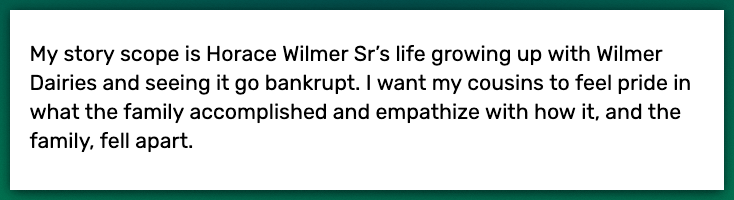
This chronicle scope below covers the life of one ancestor and his experience of growing up on a dairy farm, taking it over, and then living through the bankruptcy. It does not cover the life of his children or his parents, or any of the typical genealogical data dumps. The theme and focus is only on him and the dairy, so that my family can empathize with what his life was like and what he went through.
Learn more about the Scope step →
T — Thread
Thread is the chronological foundation. You take all the source documents inside your scope and arrange the facts on a timeline.
This is not just a list of dates. The thread includes three layers: what the records say happened, what was happening in the community at the same time, and where the gaps are — the years with no documentation.
The gap identification is what makes the thread different from a research summary. A research summary tells you what you know. A thread shows you what you know, what you don't know, and where the story's tension lives.
AI tools are useful here. Upload your documents to Claude, ask for a chronological timeline with confidence levels. Claude will organize the facts and flag where the evidence is strong versus thin. You still source every entry, but the structural work that takes hours by hand takes minutes.
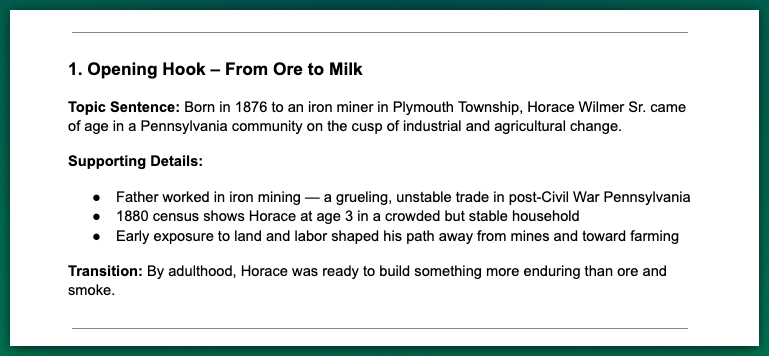
Here is an example of the what the outline for the opening paragraph looks like for my story of Horace and dairy. There are eight more paragraph outlines like this for the rest of the chronicle.
Learn more about the Thread step →
O — Originate
Originate is the first draft. This is where most family historians freeze. The Thread is done. The evidence is organized. The blank page appears. Nothing happens.
The STORI Method handles this with scaffolding. You don't write a perfect story on the first pass. You produce a rough draft — start to finish, imperfect, missing pieces and all — that you can revise.
You choose a narrator approach: third-person omniscient (you narrate from above, moving freely through time), third-person limited (you stay close to what the ancestor could have known), or first-person reflective (you write as yourself looking back at your ancestor's life). Or perhaps you have a personal hybrid style you prefer.
AI helps here too. Ask Claude to produce section outlines, opening paragraph options, transition suggestions. Not a finished story — scaffolding. You tear it apart and rebuild it in your own voice. The AI removes the blank-page paralysis. You supply the judgment, the family knowledge, and the voice that makes it real.
The output is a complete first draft. Rough. Imperfect. But finished from start to end.
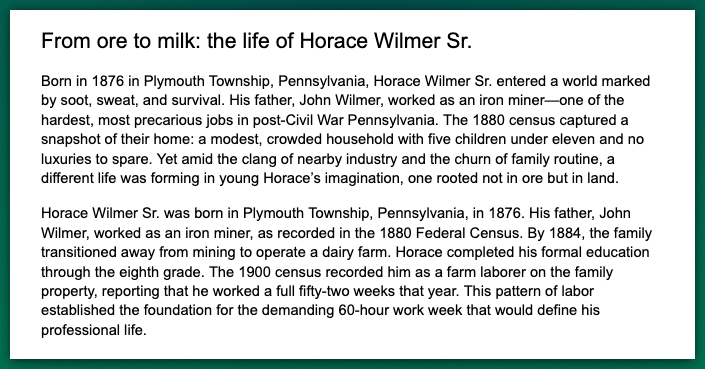
Here's two different version of the opening paragraph for the chronicle. I'm not in love with either one of them, but there are items I like in each one. From this I can write what I want now that I got over the blank page.
Learn more about the Originate step →
R — Reflect
Reflect is structured revision. Not "read it again and fix what sounds wrong." A specific checklist applied to the draft.
Seven questions drive the revision: Is the narrator voice consistent throughout? Is every factual claim supported by a source? Are gaps acknowledged, not papered over? Is historical context woven in naturally or dumped in blocks? Does the story move somewhere — is there tension, change, resolution? Would someone who never met this ancestor care about them after reading? Does every claim have a source in the notes?
Then you share the draft with at least one other person. Not for praise — for honest feedback. "Where did you lose interest? Where did you want more? What confused you?"
Inside Chronicle Makers, this happens in the Sprint review sessions. Members read each other's drafts. The feedback is specific, kind, and focused on making the story work. Outside the community, share with a family member, a writing partner, or a trusted friend who reads.
The output is a polished second draft. Not perfect. Better.
Learn more about the Reflect step →
I — Inspire
Inspire is the step most writing processes leave out. You finish the chronicle. You share it. Then you ask: what's next?
Three questions close the loop: What material surfaced during this chronicle that deserves its own story? Which family members responded most strongly, and what do they want to read next? What research gaps, if filled, would produce the richest next chronicle?
The goal of the STORI Method is not one story. It's a practice of chronicle-making. Each finished story teaches you something that makes the next one better. Each chronicle opens doors to the next ancestor, the next question, the next piece of your family's history.
This is why the method is called STORI, not STOR. The "I" keeps the cycle moving. You don't write one chronicle and stop. You write one, and then you write the next one, and then the next.
Learn more about the Inspire step →
Why the order matters
Every step depends on the one before it.
Without Scope, the Thread tries to include everything and becomes unusable.
Without the Thread, the first draft has no structure and collapses under its own weight.
Without Originate (an actual draft, however rough), Reflect has nothing to revise.
Without Reflect, you publish something that doesn't work as well as it could.
Without Inspire, you finish a story and never share it.
The order is the method. Skip a step and you're back to the same stuckness that kept you from finishing before.
How the Sprint uses STORI
The 10-Day Chronicle Writing Sprint inside Chronicle Makers maps directly to the STORI steps. Day 1 is Scope. Days 2-4 are Thread. Days 5-7 are Originate. Days 8-9 are Reflect. Day 10 is Inspire — finishing, sharing, and planning the next one.
95% of Sprint participants finish a complete chronicle.
The number matters because most genealogy programs don't publish a completion rate. The Sprint publishes one because the structure works. Ten days. One ancestor. One finished story your family reads.
The step-by-step approach really helped me get started and finish. I'm happy with my finished product." — Holly Beck
Getting started with STORI
You don't need to join anything to start using the method. Pick one ancestor. Answer the five Scope questions. Build a Thread from the records you have. Write a rough draft. Revise it. Share it.
If you want the full structure — daily modules, peer review, live sessions, AI guidance at every step — that's what the Chronicle Writing Sprint is for.
If you want to understand the method at a deeper level — each step with examples, common traps, and the thinking behind the design — the STORI Method hub page has it all.