AI as Your Writing Coach for Family History
AI can coach the family history you have already written, without writing a word of it for you. What a coaching pass returns and why it works.

AI can coach the family history you have already written without writing a word of it for you.
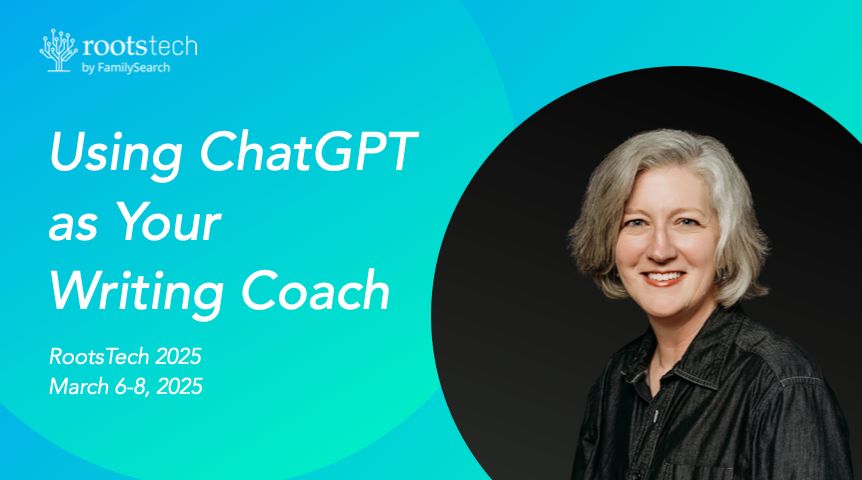
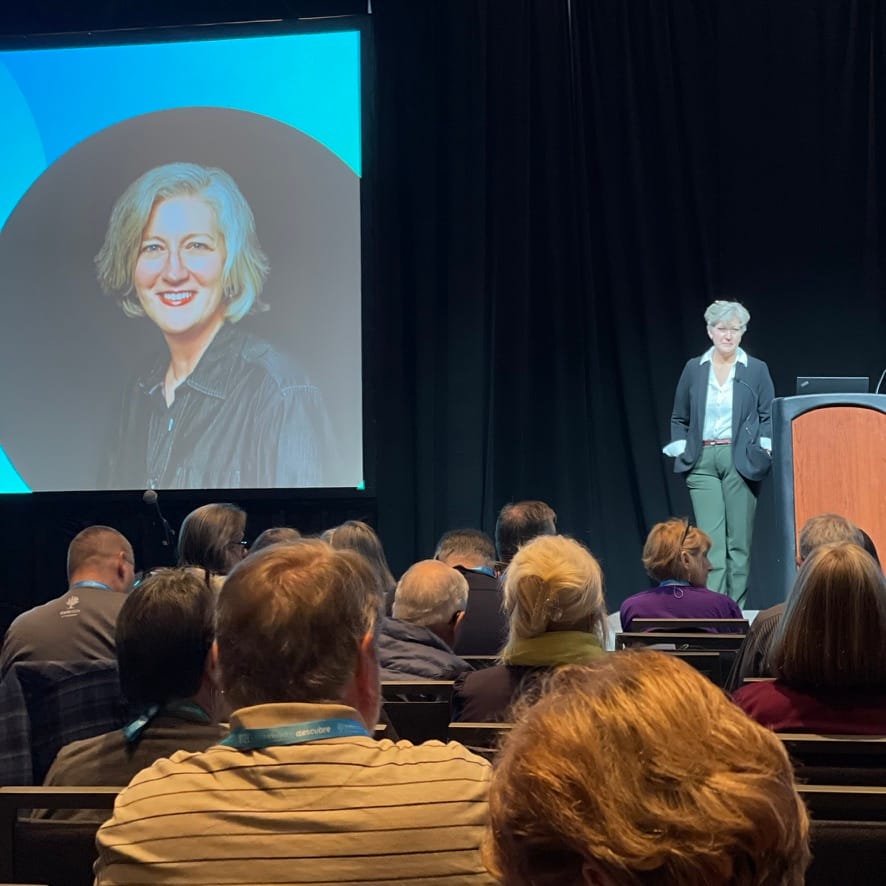
I first taught this at RootsTech 2025, "Using ChatGPT as Your Personal Writing Coach," March 8, 2025, to a room of 295 people at 8 a.m. on a Saturday. The session was never recorded and its listing has since come off the RootsTech site, which is exactly why this page exists: it is the permanent home of the framework, so anyone who meets it — at a conference, in a course, on a handout — can trace it to the source and see how my ideas evolved.
Here is what the framework is and why it works when "AI, write my family history" fails.
What "AI as Writing Coach" means
A writing coach does not write. A writing coach reads what you wrote and hands it back with the problems named.
That is the whole distinction. Most family historians meet AI as a ghostwriter — paste in facts, receive paragraphs that sounds like...well, like AI wrote it. The coach frame runs the opposite direction. You bring writing that already exists: a blog post from 2019, a chapter draft, the ancestor sketch sitting in a folder since the pandemic. The tool reads it the way an editor would and returns what an editor returns — where the story loses the reader, where a fact is doing no work, where your voice went flat because you wrote like you were proving facts.
The word choice is yours. Every rewrite is a decision you make, not an output you paste. That is what separates a chronicle you wrote from a chronicle you ordered.
What a coaching pass returns
Run a piece of your existing writing through a coaching pass and you get back three things.
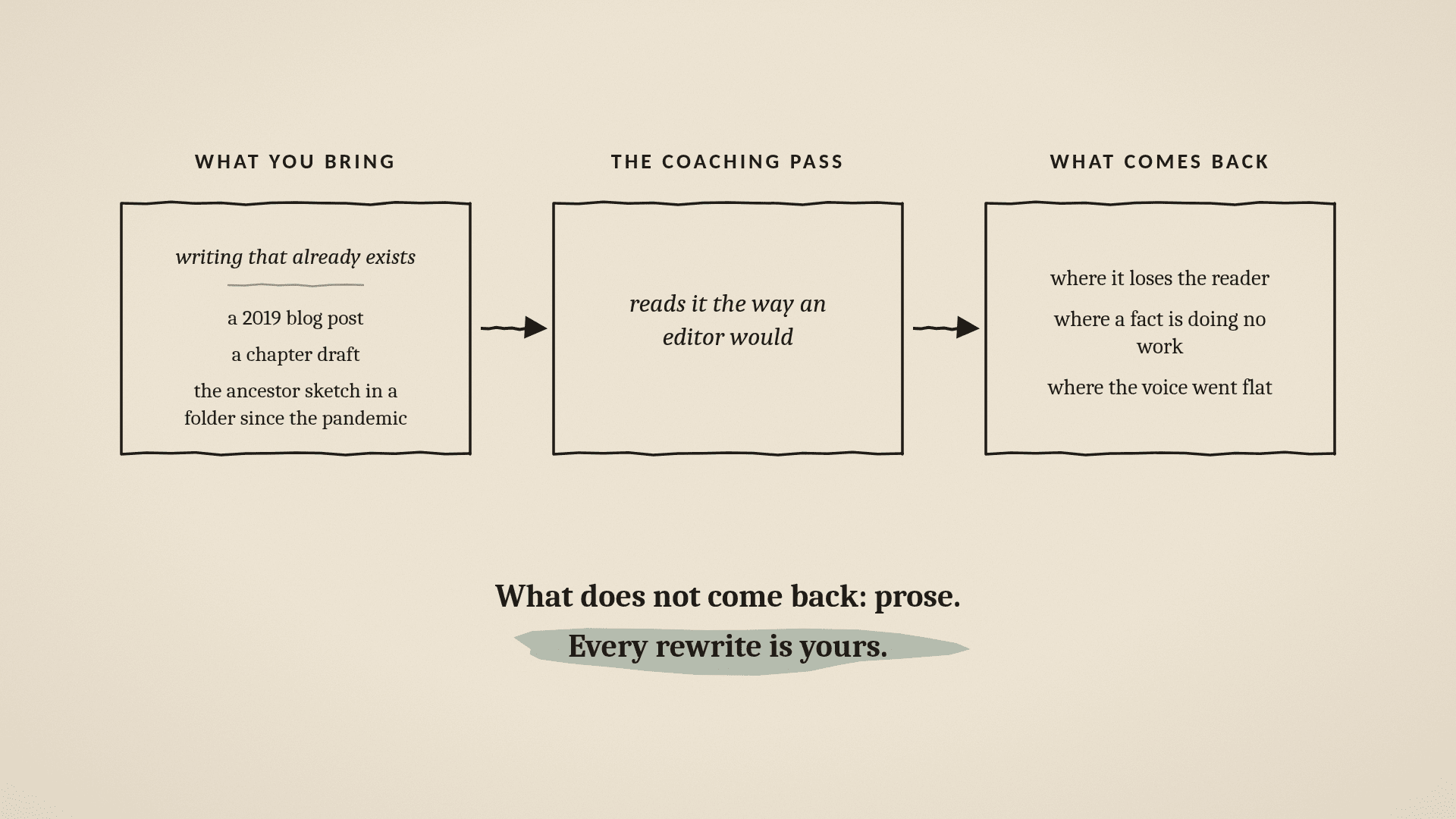
Where the writing loses its reader. The paragraph that lists four dates in a row. The opening that starts with a birth instead of the middle of the action. Too many ancestors jumbled together, rather than focusing on one and her story.
Where facts sit without story. Family historians write "John was born in 1832, married in 1855, and died in 1901" because that is what the records say. A coach names the gap: which of these moments carries the story, and what happened between them that the reader needs.
Where your voice disappeared. Everyone's drafts go generic in the hard paragraphs. A coaching pass can show you the sentence where you stopped sounding like yourself and hand it back for you to rewrite, not rewrite it for you.
Why this beats "AI, write it for me"
Because the finished chronicle has to survive one test: a family member reading it and hearing your voice in the writing.
Generated prose fails that test. Coached prose passes it, because the choosing, cutting, and rewriting were yours. All the tool did was what a good editor does.
This is also why the coach frame works on writing at every level. It does not require a finished manuscript. A three-paragraph research note qualifies. If you wrote it, it can be coached.
Where this framework came from
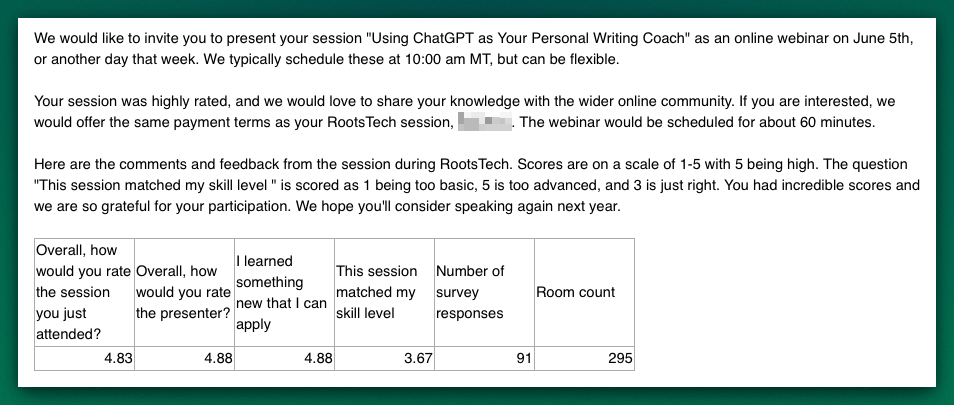
I first proposed this session to RootsTech in July 2024, based off how I worked with ChatGPT at the time. I announced this session on my own site in January 2025, fifty days out, built it, and delivered it to a full room in Salt Lake City on March 8, 2025. Across 91 survey responses, the session rated 4.83 and I rated 4.88 as a presenter. It was hit and for months family historians emailed me about it.
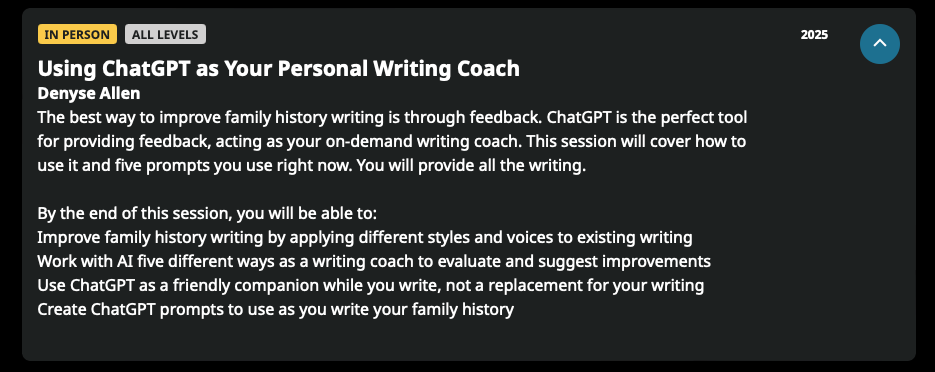
The catalog description promised what the framework still promises: AI as "the perfect tool for providing feedback." One line in that listing I would not write today, "a friendly companion while you write." My thinking evolved in the last year.
The organizers' follow-up ranked it among the top-rated sessions of the conference.
The framework has since grown into the writing layer of the Chronicle Makers system, where it operates alongside the STORI Method. STORI carries a chronicle from research to finished draft, and the writing-coach frame improves writing that already exists.
Where it fits in the Chronicle Makers system
Improving existing writing is the front porch. Members who want the full path (research inventory to finished, delivered chronicle) work inside the Chronicle Makers community, where the coaching runs on tools built for family history specifically.
When you use AI as a coach, not just a ghostwriter, you end up with writing your family can actually read, in your own voice, finished.
FAQ
What is the "AI as Writing Coach" framework?
A method for using AI to review and improve family history writing you have already produced, originated by Denyse Allen and first taught at RootsTech 2025. The tool reads like an editor and returns problems for the writer to fix; it never produces the finished prose.
Does the AI rewrite my family history?
No. It names what to fix and tells you specifically where to fix it in your writing. The rewriting is yours, which is why the finished chronicle is yours.
Do I need a finished manuscript to use this?
No. Any existing writing qualifies — blog posts, draft chapters, research notes with narrative in them.
Where was this first taught?
RootsTech 2025, Salt Lake City on March 8, 2025, in person, to a room of 295. The session was announced on the author's site in January 2025 and was among the top-rated sessions of the conference. It was not recorded; this page is its permanent home.