What a Finished Family History Actually Looks Like
A finished family history is one a reader has read. Not a complete tree, not exhausted sources — a chronicle someone who is not you has actually read.

A finished family history is one a reader has read. That's it, and it is the one nobody in this field will give you.
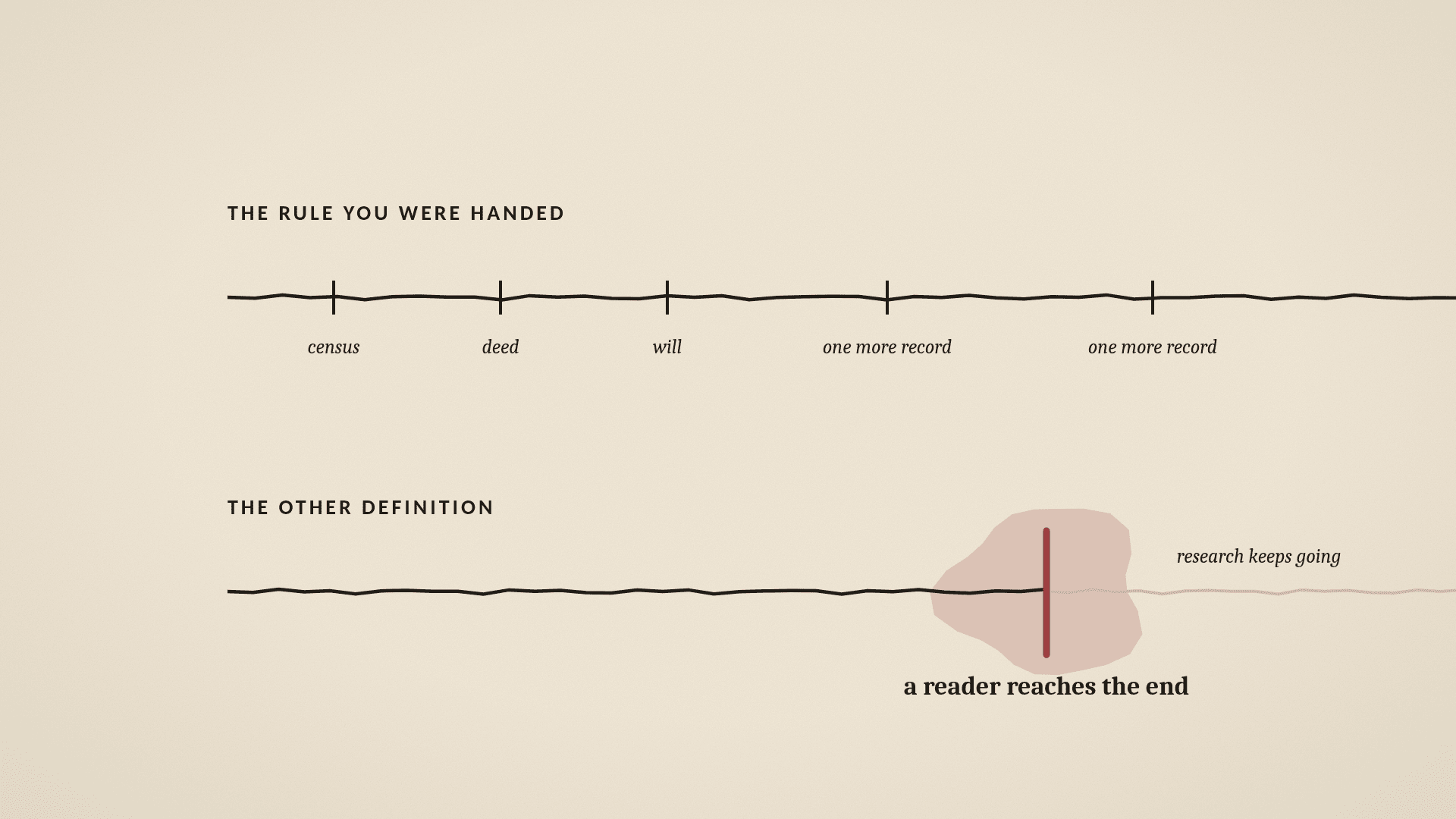
You will be told, kindly and often, that research is never done. And it has been repeated so long and so often that it has stopped being a caution and started being a rule. Under that rule nothing you have can ever be handed to anyone, because there is always one more record you should be looking for.
This page gives you the other definition. Finished is a state your work can actually reach, it is defined by a reader rather than by a database, and a new record arriving afterward does not undo it.
Why family historians are told the work is never done
This is not a slogan someone invented for a sales page. It sits in peer-reviewed literature about the field.
In 2004, Elizabeth Yakel interviewed genealogists and family historians for Information Research and described the activity as one with no clear end point: once the chart is filled in, the search moves on to the lives behind the names. As one of her participants put it — "you never get done. Never get done."
Notice what also happens when "never done" is normalized. An activity that cannot finish generates permanent demand — another course, another webinar, another society membership, another conference, another year of the subscription. Never being done is the product.
Nobody had to conspire for this by the way. The genealogy industry simply grew up around a definition that tells people there is always more research to do, so to share or write or publish about what you already have, is premature and foolish. The never done standard keep customers, because to cancel your subscription feels like giving up.
I am not asking you to be angry about it. I am asking you to notice that the rule you have been handed serves the people handing it to you. You can approach family history in a different way.
Finished is defined by a person, not by an industry
Here is the competing definition.
A family history is finished when someone (who is not you) has read it and understood the life it describes and how the sources prove the facts. Not when the tree reaches a specific number of generations. Not when you've exhausted yourself. Not when you are tired of spending money for subscriptions. When a person read the family history and understands it.
That test moves the finish line off the research and onto the delivery, which is where it belongs. Research genuinely has no end — Yakel is right about that. A story has an end, because a reader defines it. The two things were collapsed into one for so long that finishing a story came to feel like claiming your research was complete. It never was that claim.
This is why I use the word chronicle rather than "project." A project is a container that can stay open forever. A chronicle is a thing you hand to someone.
A database is not a finished family history
The most capable family historians I know are often the furthest from finishing, and it looks like infrastructure.
I watch it in my own audience every month. A commenter describes a system running across multiple tools, AI sub-agents researching several ancestors at once, a home server indexing their own scans. Four hundred thousand records collected since 2012. Incredible volume of work and still nothing anyone has read.
A working pipeline never has to end, so it never has to be judged. That is what makes it the most defensible form of not finishing available: every hour spent on it reads as progress. A database has no reader. A story has one. Anything that never reaches a human who is not you is not finished work. It is stocked shelves.
Building the system is not the mistake. Believing the system is the destination is.
The two ways research is shared now
If a chronicle is a finished thing, look at what family historians actually hand over instead. There are two formats in common use and neither one works.
The first is the tree. A family tree is a pedigree chart and it answers exactly one question: who connects to whom. It is a data structure, so a relative studies it, says something kind about how much work that must have been, and puts it down.
The second is the talk, and I worked out what it is in a video I made after a conference in 2025. (This is bit of a long observation, so stick with me, it's worth it.) I went to this state conference to teach Pennsylvania records. I had a table in the vendor hall, my books, three prepared sessions. For three days almost nobody asked me where to find records to help their research. Instead people told me their entire research journeys instead, one after another. What they found, how they felt about it, and why this ancestor or that one was so interesting. It took me most of the weekend to understand that they were reaching for connection, while I had shown up with information.
The comments on that video explained what happened better than I did. Nearly nine thousand people watched it, and the most-liked response was a family historian saying that so few people care about the extensive research we do that it feels miraculous to meet someone who does. Others said the same thing in their own words: no one at home to talk to, a daughter who is not interested, a father who cared and has died. One viewer described the whole mechanism in a sentence — people with stories and nobody to tell them to will tell any active or captive listener, and what they are looking for is acknowledgement of their effort.
An archivist wrote that the same thing happens at his desk every week, and then admitted he does it himself to other archivists. A certified genealogist wrote that she has stopped mentioning her own ancestors to anyone, and now speaks only when she has a specific question to ask.
Read all those comments together and the picture changes. Family historians have nowhere to put their work at all, so decades of it come out at whoever will stand still and listen. Sit with the impact of that for a moment. Untold numbers of people have dedicated years of their lives to something that means everything to them, and many only have strangers to share it with.
Why the written chronicle is the better way to share
What a family historian wants is to be understood, and being understood needs something the other person can carry away. A patient listener nodding is politeness, and everyone can feel the difference between politeness and recognition. When the talking ends, what was said is soon forgotten.
The listener is stuck too. They cannot slow it down, come back to the confusing part or try to end the conversation without hurting someone they love. So they nod politely, and that reaction is what teaches a researcher to stop sharing.
A document changes the terms. A reader starts when they want, goes back over the part that confused them, stops when it gets heavy, and picks it up again later. Nobody is trapped, so nobody is performing. That is the only condition under which a person actually takes something in.
That is what the chronicle format is for. Not a prettier tree, and not the talk written down. It is what those conference attendees want and it reaches the people who are not in the room.
What happens when a new record arrives after you finish
This is the fear underneath the never-done belief, so let me deal with it directly.
You finish an ancestor's chronicle. You send it to your family. Two months later the packet you ordered months ago finally arrives, and it changes part of the storyline — a hypothesis you had marked as likely turns out to be documented fact.
Did you finish too early?
No. One of our members lived exactly that sequence recently, and what she wrote about it was "woohoo" — because the chronicle had gone out as a shared document, she could update it, tell her family, and let them read the updated version. Her family got to experience what it is like when new research is added to the ancestor's story. It was something to celebrate, not a short of shame.
This is a structural property of finished work done with the Chronicle Makers methods. A new record breaks an undocumented tree. That same new record updates a documented chronicle. When you have written down what you knew, what you did not know, and how confident you were in each, a later document has somewhere to land.
The people most afraid of being wrong later are the people who never wrote anything down.
How to know your chronicle is honestly finished
There are two different questions hiding in "am I done".
The first is whether the research supports what you have written. That is a question with a real answer, and it is what the Soundness Standard exists to settle — it asks whether every claim in the chronicle is carried by the evidence you actually hold, and it hands back the places where it is not. Unresolved things ship marked as unresolved. Saying "I do not know how she got from Chester County to Ohio" inside a finished chronicle is a finished sentence, not an unfinished one.
The second question is whether the writing is good enough, and that one is answered by a person reading it, not by more research. Family historians reliably get anxious about research gaps, then go back to the records to soothe it. The records cannot soothe it, because there might not ever be records that can cover that gap. Writing about the gaps honestly it how you reach "done".
The Research Quality Check sits upstream of both. It reports where a family group's evidence agrees and where it disagrees, so the writing starts from a known state instead of a hopeful one.
What a finished family history looks like when you give it to someone
I brought eight typed pages about a vanished Pennsylvania coal town to my cousin's seventieth birthday party. My great-grandparents lived there. The town is ruins in a state forest now, so there is nothing for us to visit and return to. But we could share the stories I collected and feel gratitude together for our ancestors' lives. I returned from that party with suggestions to add more pictures and a lead for another cousin who might have some.
That is what finished looks like. The chronicle goes out, it gets read, it gets a reaction, and the reaction improves the next version. No expectation of perfection. Just honest sharing and collecting feedback for the next version.
The work you have done is worth more than the shape it is currently in. Thirty years in a database is thirty years of data collection. The same thirty years of data in a chronicle your niece finishes on a Sunday afternoon is the thing you were doing it for all along . and the research does not have to stop for that to be true. It never stops. It just stops being the reason nothing gets handed to anyone.
You can finish. You can be confident it is right. You can send it, and when the next record turns up, you can send an updated version that both you and your family can celebrate.