Is It Cheating to Use AI to Write Your Family History?
Is it cheating to use AI to write your family history? No. Cheating needs a competition with rules and you never entered one. Here's the real answer.

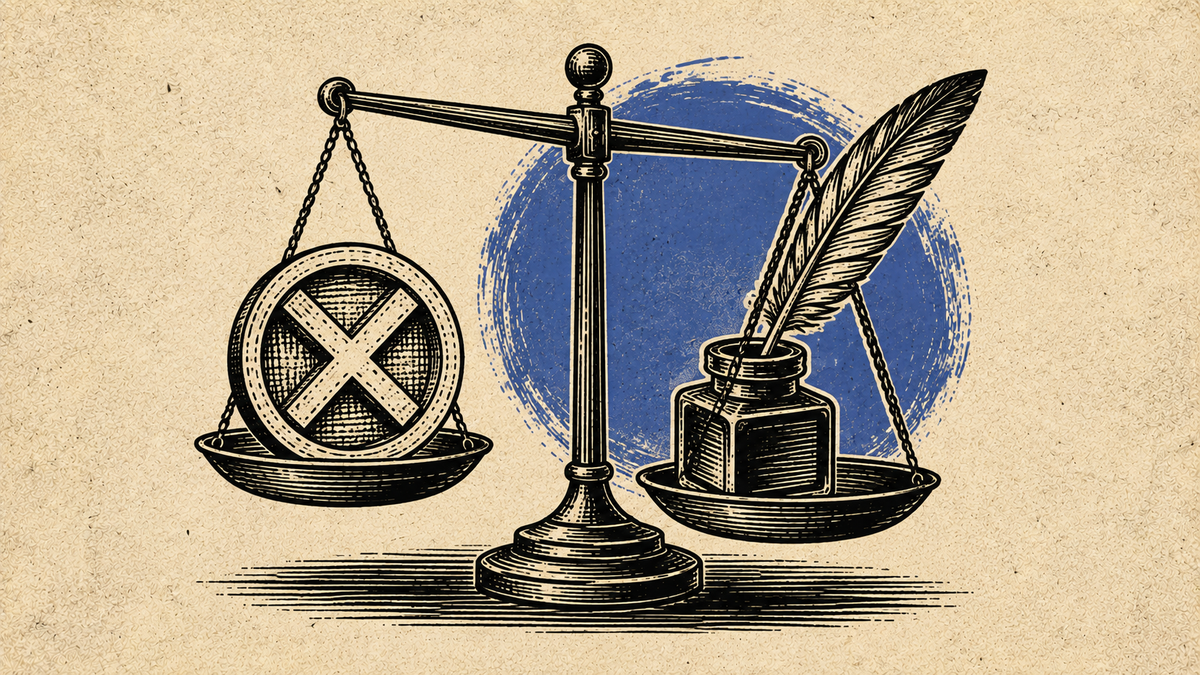
No, it's not cheating. And here's the part that matters: cheating requires a competition, with rules, with stakes, that you agreed to enter. You didn't. You're writing your great-grandmother's story for your grandchildren. There is no game. There is no panel of judges. So there is nothing to cheat at.
If you've felt a flicker of guilt about opening Claude or ChatGPT to help write your family's story, this article is for you. The guilt is real, but the premise behind it does not survive a second look.
Where the word "cheating" comes from
Listen to who uses the word. "Cheating" comes from people for whom writing is a competition — where being good at it earns status, and where a tool that helps everyone write threatens the value of being one of the few who could. That's a real anxiety, but it's theirs, not yours. When you hear the hand-wringing about the ethics of AI and writing, picture the fainting couch. Much of it is performance.
Cheating implies an agreed set of rules, a contest with defined terms, a result that matters in a particular way. Ask the simple question and the whole accusation falls apart: What competition am I in? Whose rules am I breaking? A family historian writing a chronicle for her family has not entered any contest. There are no rules to violate. The word does not apply.
You don't have to defend your use of AI. You just have to notice that the accusation assumes your are participating in a game you were never playing.
Whose stories disappear if the tool is off-limits
Here is what the "cheating" charge actually does, underneath the theater. It decides whose family stories get to exist.
The people who reach for the word "cheating" are almost always gifted writers. Words come easily to them. They have never stared at a blank page knowing exactly what they want to say and having no idea how to get it down. So when they say "just write it yourself," they're speaking from a place where writing was never the barrier. For them it isn't. For millions of others, it's a wall between everything they know and anything their family will ever read.
Think about who's on the other side of that wall. The woman whose hands shake too badly to type for more than a few minutes. The veteran whose injury made his thoughts come faster than his fingers can catch them. The immigrant whose family story spans three continents in a language that isn't her first. The 55-year-old with dyslexia who spent a lifetime avoiding the page. The 72-year-old organizing her memories against a clock she didn't set. Every one of them did the research. Every one of them holds a story no one else alive can tell. The only thing standing between that story and the page is the writing — and AI is the first tool that removes exactly that barrier and nothing else.
Calling that cheating is like calling a wheelchair cheating at mobility. The person still has to get where they're going. The tool just removes the obstacle that had nothing to do with the destination. To rule the tool out of bounds is to decide, quietly, that those stories should stay locked in someone's head until they're gone. The most research often sits with the people who have the least time and the hardest road to the page. They are precisely who family history exists to preserve — and precisely who gets shut out when the door is held by people for whom writing was always easy.
That's the real stakes. Not standards. Not purity. Whose ancestors get remembered.
AI is a tool. That's the whole thing.
Every generation of writers used the tools of its time. The typewriter was going to ruin "real" writing. So was the word processor. So was spell-check, and the internet, and Wikipedia. Each one was going to make writing too easy, too cheap, not earned, with fake sources attached. Each one simply became how the work got done.
AI is the newest tool in that line. It does not write your family's story for you (not well, anyway). What it does is remove the blank page. It helps you organize twenty years of records into a timeline, draft a rough opening you'll rewrite, untangle a confusing sequence of events. You bring the research, the perspective, the family knowledge, and the voice. The tool brings speed. That's a tool. Tools aren't cheating. They're how things get made.
The line that actually matters
There is one real distinction, and it has nothing to do with permission. It's this: who made the choices.
AI is a tool. Like any tool, you take the training to use it, then you apply it to the problem in front of you. The story is yours when the choices are yours: you gathered the records, you decided what the story is about, you measured every fact the tool gave you against your original sources, and you wrote it in your own voice. This is the AIM approach: Assess what the tool produces, Interact to refine it, Measure it against your sources. Do that, and the story is unmistakably yours.
The only way to actually "cheat" yourself here is to skip that part — to let the machine invent names and dates you never checked and publish them as fact. That's not cheating at a competition. That's just producing something untrue, and it reads exactly as hollow as it is.
"But what will people think?"
Here is the fear underneath. You're less worried about an abstract rule than about someone in your family, your writers' group, or a genealogy circle saying the word to your face.
If that happens, you don't argue. You ask the question: What competition do you think I've entered? Let them explain whose rules you're supposedly breaking and what the stakes are. They can't, because there aren't any. The chronicle is for your grandchildren, not a judging panel. The accusation collapses the moment someone has to defend it out loud.
And if transparency settles your own mind, a single line does it: "I used AI to help me write this; the research and the writing are mine." Several of the finished chronicles on this site carry exactly that note, in the authors' own words. It costs nothing and ends the conversation.
The bottom line
It is not cheating to use AI to write your family history. Cheating needs a game you entered and rules you agreed to, and you have neither. What you have is a tool, the latest in a long line of them, and a story that has been sitting in your files for years waiting to be finished.
The people performing concern about the ethics of it will be fine. Meanwhile, you could have your great-grandmother's story written by the weekend. Use the tool. Finish the story.
If you're ready, the STORI Method is the five-step process for turning your research into a finished chronicle — and the chronicles other family historians have finished show what it looks like when the tool is used well.
FAQ
Is it cheating to use AI to write family history?
No. Cheating requires a competition with agreed rules and stakes, and writing your family's story for your family is not a contest. There is no game to cheat at. As long as you do the research, make the decisions, measure facts against your sources, and write in your own voice, the story is yours and AI is simply a tool that helped you finish.
Is a family history story written with AI's help still mine?
Yes, when the choices are yours. AI that helps organize a timeline or draft a rough opening is a tool, not the author. You made the research decisions, you measured the facts, you selected the history, you chose the words that stayed. The finished story reflects your knowledge, perspective, and voice.
Why do people say using AI to write is cheating?
The word usually comes from people for whom writing is a status competition — where a tool that helps everyone write threatens the value of being one of the few who could. That anxiety is theirs, not yours. If you never entered a writing contest, there are no rules for you to break.
Is it OK to use AI if I'm not a strong writer?
Yes — this is exactly who AI helps most. People with shaking hands, a brain injury, dyslexia, a first language that isn't English, or simply a lifetime spent doing something other than writing all hold family stories worth preserving. AI removes the writing barrier without touching the research, the perspective, or the truth of the story. Calling that cheating shuts out the people family history exists to preserve.
Should I disclose that I used AI to write my family history?
It's a personal choice, but a simple note — "I used AI to help write this; the research and writing are mine" — settles the question and protects the trust your work earns. Many family historians include a line like this at the end of a finished chronicle.
What's the difference between using AI and letting AI write it for you?
Using AI means the tool does jobs while you make the choices: organizing research, drafting scaffolding you rewrite, untangling sequences. Letting AI write it for you ("Write a biography of X") means the choices stop being yours: you accept whatever it generates without measuring it against your standards and knowledge. The first produces a story that's truly yours. The second produces generic, often inaccurate text that isn't, and that's the only real way to shortchange the work.