How AI Can Help Organize Genealogy Research
How to use AI to organize genealogy research: build timelines, create inventories, find gaps, and get your files ready to write from.

You have twenty years of research. It lives in three binders, two hard drives, a filing cabinet, and forty-seven browser tabs you haven't closed.
You know who your ancestors are. You cannot find the documents when you need them.
This is the most common bottleneck in family history — not a lack of information but a lack of organization that makes the information usable. AI can fix this in a fraction of the time it would take you to do it by hand.
The real problem with genealogy organization
Most genealogy organization advice tells you to build a filing system. Buy the binders. Label the folders. Create the spreadsheet. Index every document.
That advice is fine. It is also why most people give up halfway through. Organizing twenty years of research into a perfect system is a project so large that it replaces the actual work. You spend six months organizing instead of six months writing. The organization becomes its own form of procrastination.
AI changes this equation. You don't need a perfect system. You need a working inventory of what you have for one ancestor — enough to know what's there, what's missing, and whether you have enough to start writing.
That takes an afternoon, not a month.
Four things AI does well for research organization
1.Building an inventory from a pile of documents
Upload a folder of scanned records, PDFs, and research notes to Claude. Ask it to create a chronological inventory: what documents exist, what dates they cover, which ancestor they reference, and what type of record each one is.
Claude reads the documents, identifies dates and names, and produces a structured list. In an hour, you have a clear picture of what you own for one ancestor — something that would take a full day to build by hand.
The inventory is not perfect. You verify it. Some documents will be misread, especially handwritten ones. But a 90% accurate inventory you can correct is infinitely more useful than no inventory at all.
2.Finding gaps in your research
Once you have an inventory, ask the AI to identify the gaps. "Based on these records, what time periods have no documentation? What record types are missing that would normally exist for someone living in this place during this period?"
AI knows what records typically exist for a given time and place. It can tell you that you have census records for 1850 and 1870 but not 1860. It can flag that you have no marriage record despite having children listed on a later census. It can identify that tax records exist for your ancestor's county but you haven't searched them.
The gap analysis turns "I have a lot of stuff" into "I have these specific things and I'm missing these specific things." That's the difference between being organized and being ready to write.
3.Creating a research summary
A research summary is a one-page document that captures everything you know about one ancestor: vital dates, family relationships, confirmed locations, occupation history, and the source for each fact.
Ask Claude to build one from your uploaded documents. The AI reads the records and assembles a structured profile with citations. You review it, correct errors, and fill in anything the AI missed from your personal knowledge.
This research summary becomes the foundation for everything else — your scope statement, your timeline, your first draft. It's the single most useful document in your research folder, and AI builds the first version in minutes.
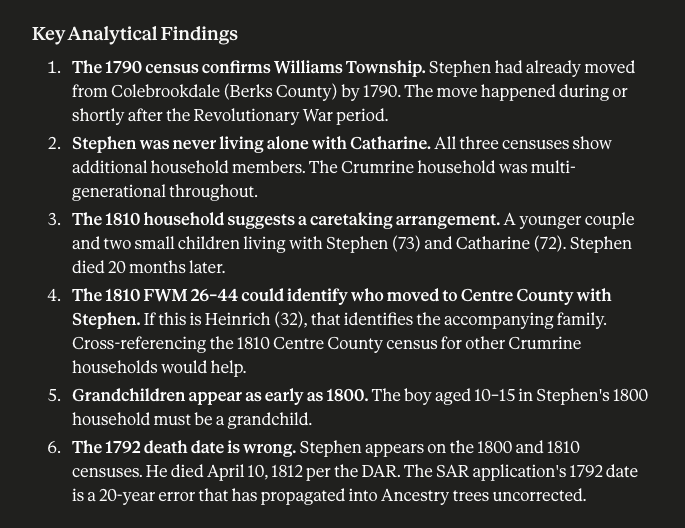
Here's a list of what Claude found across 3 census records for my Revolutionary War ancestor:
4.Sorting conflicting information
You have three documents that give three different birth years. The census says 1842. The death certificate says 1840. The family Bible says 1841.
This is normal in genealogy. What's not normal is having a tool that can lay out the conflicts clearly and assess which source is likely most reliable based on the type of record and its proximity to the event.
Upload the conflicting documents. Ask the AI to compare them and explain which is the strongest evidence. AI won't decide for you — that's your job. But it will lay out the analysis in a format you can evaluate quickly.
The workflow: organizing one ancestor in an afternoon
This is the process I recommend for getting organized enough to write. Not organized enough to satisfy a professional archivist. Organized enough to start a chronicle.
Step 1: Choose one ancestor. The one you want to write about first.
Step 2: Gather every document you have for that person into one folder. Physical or digital — it doesn't matter. Scan what needs scanning. Save what needs saving. Get it all in one place.
Step 3: Upload the folder to Claude (or your AI tool of choice). Ask for a chronological inventory with document types, dates, and names.
Step 4: Review the inventory. Correct errors. Add documents the AI missed.
Step 5: Ask the AI for a gap analysis. What time periods are undocumented? What record types are missing?
Step 6: Ask the AI to build a research summary. One page. Vital dates, relationships, locations, occupations, with the source for each fact.
Step 7: Decide: do you have enough to write, or do you need to fill a specific gap first?
That decision — write now or research one more thing — is the pivot point. If you have a scope statement, a timeline, and a research summary, you almost certainly have enough. The gap can be noted honestly in the story. You don't need to fill every hole before you start.
What AI cannot organize for you
AI handles documents. It does not handle the decisions that make research into a story.
It cannot decide which ancestor to write about first. It cannot tell you which angle will make the most compelling chronicle. It cannot replace the family knowledge you carry — the stories your grandmother told, the photograph nobody else has, the connection between a place name and a living relative.
Organization is the foundation. The story is yours.
Getting started
If you've never used AI for genealogy, start with the free 5-Day AI Beginners Course. By day five, you'll have used AI on your own records.
Start the Free 5-Day AI Course →
If you want the full picture of which AI tools work for which tasks, the AI Genealogy Guide covers everything.