The Finisher Framework: Why Most Family History Projects Stall (and How to Change That)
The Finisher Framework: the identity shift from genealogy researcher to someone who finishes family history stories. Built for people with years of research and nothing written.

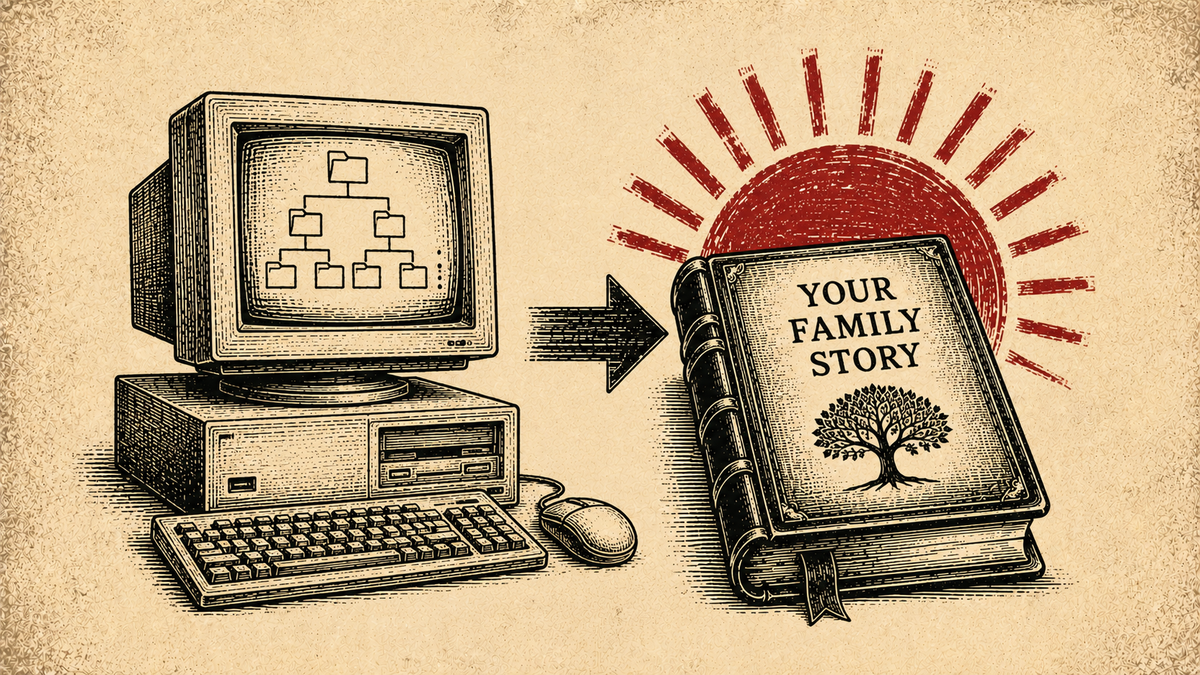
You have ten years of research. You have binders, hard drives, browser tabs full of records. You've told yourself a hundred times that this is the year you'll write something.
You haven't written anything.
This is not a discipline problem. It's an identity problem. And it has a name.
The pattern that keeps family historians stuck
Here is what happens to most genealogists. You start with a question about an ancestor. You find records. The records raise more questions. You find more records. Each discovery feels like progress because it is progress — you are learning real things about real people.
But at some point, the research becomes the project. The writing becomes the thing you'll do "once you have everything." You keep finding one more record, one more source, one more piece before you feel ready to start.
An estimated 98% of genealogists who want to write about their ancestors never finish. Not because they lack material. Because the identity of "researcher" is comfortable. The identity of "writer" feels exposed.
Research is private. You collect in silence. Nobody sees your mistakes. Writing is public. Someone reads what you made. They judge it. They might find errors. They might not care.
The shift from researcher to writer is not a skill problem. It's an identity problem.
What the Finisher Framework is
The Finisher Framework is the name for the identity shift from "researcher who hopes to one day write" to someone who finishes chronicles. It's not a process — the STORI Method is the process. The Finisher Framework is the set of beliefs and behaviors that make the process work.
Three beliefs define a Finisher:
1.A finished imperfect story is worth more than a perfect one that never gets written
This is the hardest belief for most genealogists to accept. The research culture they came from rewards thoroughness, completeness, exhaustive searches. Those are real values. But applied to writing, they produce paralysis.
A Finisher decides that the family will read a story that exists. They will never read the story you planned to write once you found one more record.
I've been researching my Wilmer family and their dairy farm for decades. The founder of the dairy, John Wilmer, was an orphan and my focus has been finding his parents (of course!). I believed I couldn't write the story of the Wilmer's without finding John's parents. Not true! My family was interested in the story of all the brothers and sisters and their children who ran the dairy along with John. I ignored writing and sharing the chronicles of the lives of twenty people because I was so focused on one brick wall. Now I feel pride in wrapping up the research that I did do and writing the chronicles I could write.
2.The writing is the research
Most genealogists treat writing as what happens after the research is done. A Finisher knows that writing reveals what you actually understand and what you don't. The draft surfaces gaps you never noticed. It forces you to decide what the evidence means, not just what it says.
Writing is not the reward for finishing research. Writing is the final stage of research. When you sit down to write and realize you can't explain how two people are connected, that is a research finding. It tells you what to look for next.
3.One chronicle opens the door to the next
The first chronicle is the hardest. Not because the research is harder or the writing is harder. Because you don't yet believe you can do it. Every Finisher I know says the same thing: the second chronicle was easier than the first by a factor of ten.
The identity shift happens when you finish one. Just one. After that, the question changes from "can I do this?" to "which ancestor is next?"
What keeps people in the researcher identity
Three forces hold genealogists in the comfortable researcher identity. Naming them is how you stop them.
The Full Pantry Problem
You have everything you need to write. Your pantry is full. And you still can't start. You reorganize your files. You re-read records you've already read. You tell yourself you need to find one more thing.
The Full Pantry Problem is the gap between having enough material and believing you have enough material. The cure is a scope statement (from the STORI Method) that draws a boundary and says: this is enough for this story. Not for every story. For this one.
Learn more about the Full Pantry Problem →
Perfectionism disguised as thoroughness
"I just want to make sure I have everything right before I start." This is perfectionism wearing the costume of a genealogical virtue. Thoroughness matters in research. Applied to the writing decision, it becomes an indefinite delay.
A Finisher writes the draft with the evidence they have and marks the gaps honestly. "No records survive from these years." "The connection between John and James is probable based on land patterns but not confirmed by any single document." This is better genealogy than waiting for certainty that will never arrive.
Isolation
You research alone. You get stuck alone. Nobody knows what you're working on. Nobody asks when it will be done. There is no accountability structure and no community of people doing the same work.
Inside Chronicle Makers, the Sprint creates artificial deadlines and peer accountability. Ten days. One ancestor. Everyone doing it together. The completion rate is 95% because the structure makes finishing the path of least resistance instead of the hardest thing in the room.
How to make the shift
You don't become a Finisher by reading about it. You become one by finishing something.
Step 1: Pick one ancestor. Not the hardest one. The one where you have enough evidence to write a short story — even if it's only five pages.
Step 2: Write a scope statement. Two sentences. Who, when, what angle, where the story stops.
Step 3: Draft the story in one sitting. Set a timer. Write badly. Write fast. Get to the end.
Step 4: Share it with one person. A family member. A friend. A fellow genealogist. Not for a grade — for a reader.
Step 5: Notice what happened. You have a finished chronicle. One that exists. One that someone read. You are now a person who finishes.
"Joining Chronicle Makers has been one of the best decisions I've made for my genealogy and writing work. It's a great course for anyone who wants to learn how to use the latest AI tools to bring family stories to life." — Melinda Bossenmeyer, California
The community where this happens
The Finisher identity is easier to build in a room full of Finishers. That's what Chronicle Makers is — a community of people who are actively writing, actively finishing, and actively starting the next one.
The 10-Day Chronicle Writing Sprint runs quarterly. The weekly clinics and practice sessions keep the work moving between Sprints. The library has recordings of every session, every technique, every worked example.
If you have research and you're ready to stop being a researcher who hopes to write someday, this is the room where the shift happens.