Markdown Files and Google's Open Knowledge Format: Why I Run Everything on Plain Text
What a markdown file is, why every LLM reads them, and why Google just made a folder of them an open standard.

As of October 2026
I've lived the last eight months in markdown files. They run everything about Chronicle Makers, and every LLM and agent I work with reads them. That context is what makes my work both fast and efficient.
Here's what a markdown file is, why I moved my work into them, and why Google Cloud published an open standard built on the same plain files.
A markdown file is plain text with a few marks
Markdown is plain text that you and an LLM can both read, and John Gruber designed it that way in 2004. Gruber, the writer behind Daring Fireball, built it with Aaron Swartz as a sounding board. The goal was a format that's easy to read and easy to write as plain text.
The marks are few. A pound sign in front of a line makes it a heading, and two asterisks around a word make it bold. A hyphen at the start of a line makes a bullet, and that covers most of what I use.
The file ends in .md, and it opens in anything: TextEdit, Notepad, Obsidian, the Files app on an iPad. Nothing sits locked inside a program that might not exist in ten years.
Each of my research projects lives in a Research Brain, and mine are folders of these files.
Why every LLM I use reads markdown
Claude, ChatGPT and Gemini (and every LLM) all read a .md file the same way. When I switch tools, the file comes with me, with nothing to export or convert. A Word document carries layers of formatting behind the words. A markdown file is the words and a handful of marks, so the tool spends its attention on what I wrote.
Andrej Karpathy's observation: "LLMs don't get bored," so they'll keep a folder of files current. Karpathy, a founding member of OpenAI and former director of AI at Tesla, posted an LLM Wiki note on April 4, 2026. It describes a folder of linked markdown pages that an LLM keeps current, while the person chooses the sources and asks the questions.
That's the shape of my week. I make the choices, and the tool keeps dozens of files tidy.
The Making Log is one running file for exactly this reason. Any tool I open next can read where I stopped.
Google just made a folder of markdown files a standard
On June 12, 2026, Sam McVeety and Amir Hormati, tech leads at Google Cloud, published the Open Knowledge Format, or OKF. It's an open specification for keeping knowledge as a directory of markdown files. Each file opens with a short block of labels, such as type, title and tags, so an agent can sort them.
Their reasons read like my last eight months. It's "just markdown," readable in any editor and stored as ordinary files. They say it isn't tied to any cloud or model provider — and they name Obsidian and Notion as places where the shape will feel familiar.
Google Cloud's Open Knowledge Format makes a folder of markdown files the neutral way to hand knowledge to an agent. OKF was built for company data and it makes sense to adopt it for family history work.
Google picked plain files as the common ground. The research I keep in markdown will open in whatever tool comes next.
You can write one this afternoon
You don't need a new program. Open the plain text editor already on your computer and type a pound sign, then an ancestor's name. List three facts underneath, each with a hyphen in front. Save it with .md at the end of the name. (On a Mac, choose Format, then Make Plain Text in TextEdit first.)
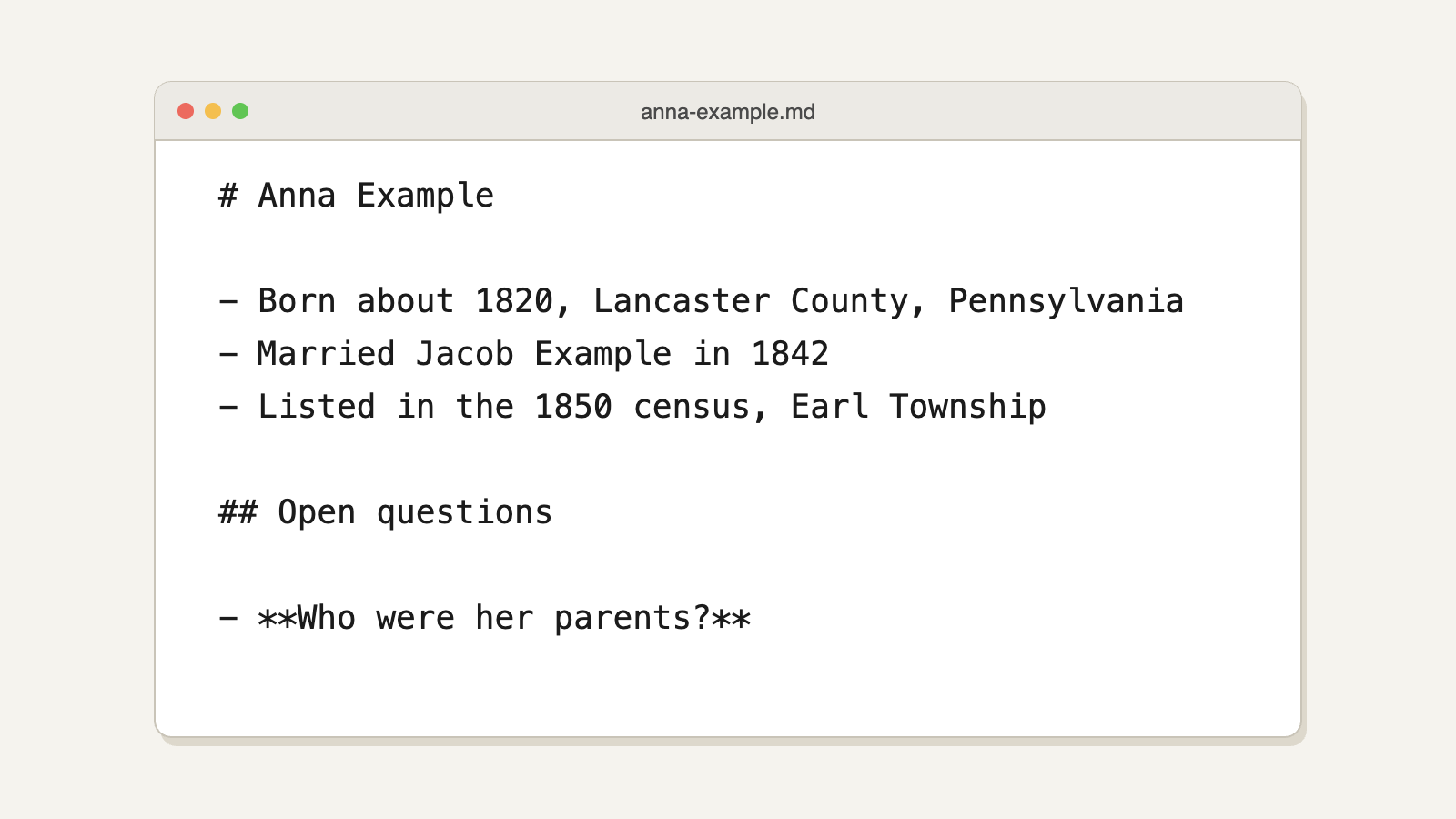
Hand that file to Claude, ChatGPT or Gemini and ask it a question about that ancestor. That's a markdown file. Everything I run at Chronicle Makers is a bigger folder of that same small thing — and it's a format your research can live in for a long time.
Follow up on your own
- AI and genealogy: the Chronicle Makers guide, my hub for everything I've written on research with LLMs
- John Gruber, Daring Fireball: Markdown, the original project page and syntax
- Andrej Karpathy, founding member of OpenAI: LLM Wiki
- Sam McVeety and Amir Hormati, Google Cloud: How the Open Knowledge Format can improve data sharing
- Google Cloud on GitHub: the OKF specification