Can Genealogy Research Be Completely Automated?
Genealogy research can’t be completely automated. Parts can go to AI tools, but knowing when research is complete depends on knowing what records should exist.

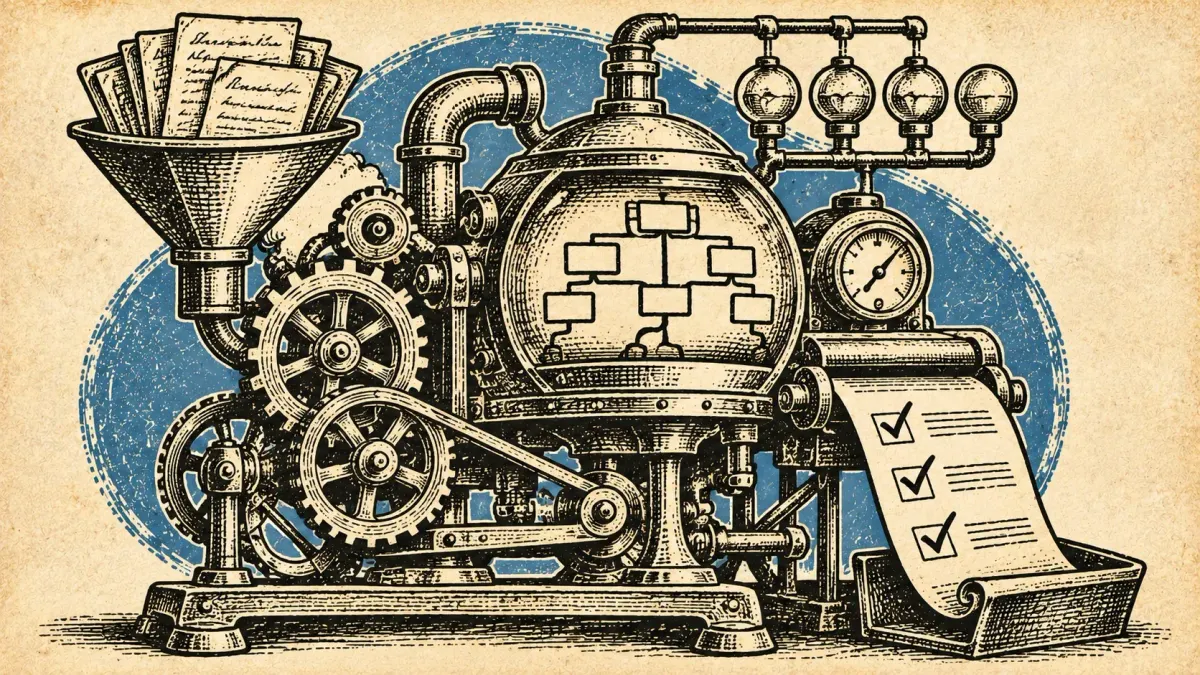
This is easy an answer: No, genealogy research can't be completely automated, and the reason isn't the technology. Parts of the work can be handed to AI tools, but the part that decides when your research is done depends on knowing what records should exist, and you can't automate what you don't understand.
The claim is everywhere this fall: spin up an agent, point it at your family, and let it run. I understand the appeal. Research is unpredictable, and anything that promises to shorten it sounds like relief to a family historian with a full folder and no finished chronicle.
This page walks through what can be handed off, what can't, and why the part that can't is the part that makes the research yours.
The parts of genealogy research AI can take on
A lot of research labor really can move to a tool. Transcription is the clearest case. A tool can read a deed or a will and hand back the text in seconds, and the old handwriting slows it down far less than it slows you.
Tools can also search a set of images for a surname, sort what you have into a timeline, and give you basic historical context for a county in a given decade. Each of those is a single task with a clear output, and you can measure each one against the original record.
That's the pattern for a good handoff. The task is narrow, the result can be checked, and you already know what a right answer looks like.
What can't be automated: knowing what complete looks like
Here's the part no tool can do. To know whether your research is complete, you have to know the whole spectrum of records created for your ancestor's time and place. This is what I call research fluency and no AI tool can replace it.
That spectrum includes the tax lists, church rolls, deeds, and court papers, plus the state census nobody mentioned and the records that burned. There are dozens of federal records few people search. And hardly anyone contacts the volunteers at the local historical society to look at their store ledgers, photographs, and toll road books. An agent sent out to "find everything" can only report what it reached. More and more sites block AI agents, and many local societies do not have their catalog on a website.
So the AI comes back with a list, and you feel done. Whether you actually are depends on human knowledge the tool never had and can't have today. If you know what should exist, you can measure the list against it — if you don't, the list quietly becomes your assumed idea of complete research.
You can't automate what you don't understand
Automation scales whatever you put into it. If you understand the steps and know what a quality result looks like, automation gets you there faster. If you don't, it gets you to a wrong answer faster, and with more confidence than you'd have had on your own.
This is the trap inside "completely automated." To automate research well, you'd need to understand each step well enough to check it. A family historian who understands the steps that well doesn't need a promise of full automation. They hand off the pieces that make sense and keep the rest without thinking twice.
Every handoff needs a checkpoint — and you're the checkpoint. No another AI model, not a better AI model. You.
Finding records was never the slow part
The pitch for automation sells finding. In my experience finding is the easy part of genealogy research, and it always was.
I once had twenty-nine records on Horace Wilmer and zero words written. I didn't need a thirtieth record. I needed to work out which records disagreed, what they actually told me (I had never transcribed them all.), and whether two documents were even the same man in one case.
That's where the expertise lives: weighing, matching, and choosing. An agent that hands you a bigger stack has done the easy part and gone quiet on the rest, and you end up with more to work through than you started with. It's the Full Pantry problem with a faster delivery truck — more groceries arriving, and still no dinner on the table.
If a machine could make it alone, it isn't your work
There's another side to the automation question. If the only result you produce is something AI could produce by itself from your documents, then you can not claim it as your work at all.
The value of your research is the choices you made. Which record you trusted, which one you set aside and why, and where you stopped. A machine can draft from your records all day, but it can't make those choices for you or stand behind them when a cousin asks how you know.
So the work has to carry you in it, which means recording how you made your choices as you go. Chronicle Makers calls that running record the Making Log, and the Making Process is the standard for what goes in it. It's also the difference between a report anyone could generate and research only you could have done.
Finishing is not the same as complete
There's one more reason full automation appeals: people want to feel like they are done. That's fair, but "done" means two different things, and mixing them up keeps projects open for years.
Finishing means you're done working, for right now. The work is noted, cited, logged, and recorded, including what's still open. Complete means every record that should exist is in hand, and most projects never get there because some records were lost and some were never made.
You can finish knowing your research isn't complete, and that's normal. The Ancestor Research Inventory is built for exactly that: a clear record of what you searched, what you found, and what's still open.
What to hand off, and what to keep
So, can research be completely automated? No, but a lot of it can be handed to tools, and you should hand off what makes sense.
Hand off the narrow tasks you can measure, like transcription, sorting, and searching a set of images you already know is the right set. Keep the knowing of what should exist, along with the reading, the choosing, and the record of how you did it.
That split is what lets you use any tool that comes along without losing your research to it. The tools will keep changing every month. The part that makes the research yours stays exactly where it's always been, with you.