The Weight of Coal Country: A Pennsylvania Miner's Life Beyond the Mines
The chronicle of Joseph Kordish, a Portage, Pennsylvania coal miner who lost an eye, taught himself electrical work, and survived the collapse of an industry. By Dawn King Carson.


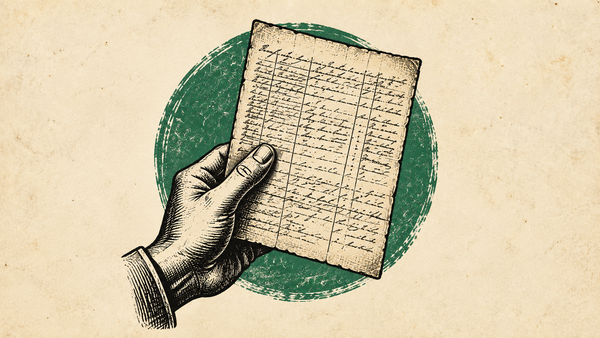
A finished family history chronicle by Chronicle Makers member Dawn King Carson, written using the STORI Method. Dawn turned census records, a draft card, a death certificate, and an interview with her mother into the story of her grandfather — a coal-town man who reinvented himself again and again as an entire industry collapsed around him.
Born on Christmas Day in a coal town
Joseph Kordish was born on Christmas Day 1911 in Portage, Pennsylvania, at the height of American coal. His parents had immigrated from Poland and Hungary to the bituminous coal region, where nearly every family's fortunes were tied to what could be pulled from the ground.
Growing up in a coal town meant breathing coal dust from childhood, hearing the mine whistles mark the days, and understanding that your father's work took place in darkness and danger. Joe was one of eight children. At eighteen he was already a miner, with eight grades of school behind him — the standard for working-class children, since skills earned in the mines mattered more than books.
A man who kept reinventing himself
Joe married Margaret Agnes Conley in 1934, in the depths of the Depression, and they raised four children. In the late 1940s, deep underground, a metal shaving cost him an eye — a week at Wills Eye Hospital in Philadelphia and a glass eye after. He went back to the mine.
But Joe had been teaching himself. Through correspondence courses and on-the-job training, he'd learned electrical work, and by 1950 he was the mine's electrician — reading blueprints, maintaining the systems that powered underground operations. His daughter remembered he once built his own television set, in 1950, with an eighth-grade education.
When the ground shifted
Then the 1950s broke coal country. Oil and gas got cheaper, homeowners and railroads switched fuels, and the mines mechanized — a few dozen men doing the work of hundreds. Cambria County unemployment hit twenty, thirty percent. Joe — past fifty, with a glass eye and a family — had done everything right and still got displaced. The family moved two hundred miles east, doubled up with their son, and came back when the work returned. He worked as an electrician until he retired.
In the context of the coal country's collapse, Joe had succeeded. But it was success that required constant adaptation, frequent sacrifice, and the willingness to keep going when easier paths would have been to give up.
[The full chronicle follows Joe through the Depression, the war years, the eye injury, the collapse of coal, the move to Graterford and back, and the health toll the mines exacted decades later — fully sourced to census records, his draft card, vital records, and an interview with his daughter.]
Read the full chronicle
Read the complete chronicle of Joseph Kordish (PDF):
Written using the STORI Method, with Claude and revised extensively by the author. Dawn came in wanting a repeatable process and now has 15 chronicles she's shared with her children. In her words:
"I felt like I'd taken a pile of 'stuff' and spun it into what will become a plethora of wonderful stories."
That's AI-collaborative family history writing — the research and the voice are Dawn's; the tool helped connect scattered records into a story worth reading.
See more finished stories on the Chronicles page, learn the STORI Method, or read about how much research is enough before writing.
Want to write your family's chronicle?
Dawn had decades of research and wanted a process she could repeat. That's what Chronicle Makers is built for.