Three Cows and a Tea Kettle: A Revolutionary War Soldier's Life
The chronicle of John Truax, a Revolutionary War Continental soldier whose decades of service were reduced to sworn testimony and an inventory of near-poverty. By Erin Hoover.


A finished family history chronicle by Chronicle Makers member Erin Hoover, written using the STORI Method. Erin reconstructed her fifth-great-grandfather's Revolutionary War service from pension files, muster rolls, and the affidavits of the men who fought beside him — a life the records had flattened into an inventory of what little he owned.
What a soldier owned at seventy
Three milk cows. Four yearling pigs. Ten fowl. Four iron pots. One tea kettle. Six earthen plates. Half a dozen cups and saucers. Half a dozen knives and forks. One small looking glass.
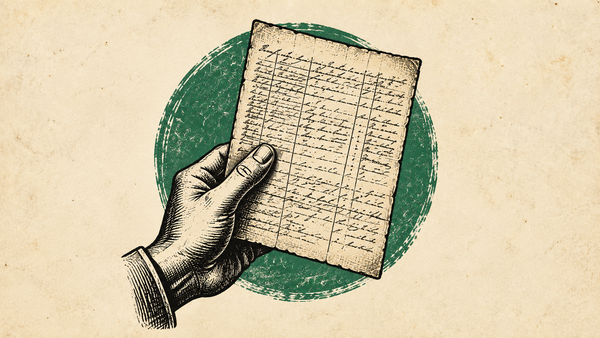
This is what John Truax owned in 1820, at age seventy, when he appeared before the Court of Common Pleas in St. Lawrence County, New York, to prove he was poor enough to keep his pension. The court valued his property at $84.62. He'd been a cooper, a craftsman who shaped barrel staves and fitted iron hoops, but was "at present unable to follow it." The pension, once he finally received it, was $8 a month. It had taken two years, three witness affidavits, and this itemized inventory of near-poverty to secure it.
Taking up arms
By 1775, John was a married man with a young family in Schenectady. He enlisted first in the Tryon County Minutemen, the local rapid-response force for the Mohawk Valley. Then in March 1777, at twenty-seven, he made a different choice — Captain Giles Wolcott's company of Colonel Seth Warner's Regiment, for "the duration of the war." This was the Continental Army: formal enlistment, extended service, the Lake Champlain–Lake George corridor against British forces moving south from Canada.
He helped cover the American retreat from Ticonderoga, reinforced the victory at Bennington, and held a thin frontier through long stretches of garrison duty and sudden violence. In October 1780, Fort George fell; his regiment was "almost wholly cut up and destroyed," and he was paroled at Saratoga and sent home.
And then he went back
The regiment no longer existed. The war was not over, but his part in it seemed to be. And then, in April 1781, John Truax mustered into Willett's Levies and went back to defend a Mohawk Valley that was still burning. He served through the war's end, alongside the same neighbors who would, forty years later, swear before judges that yes, John Truax had served, and yes, they had been there with him.
Three cows and a tea kettle. That's what remained.
[The full chronicle traces John's whole service — Bennington, Ticonderoga, the disaster at Fort George, Willett's Levies — and the pension fight at the end of his life, fully sourced to compiled service records, muster rolls, affidavits, and battle accounts held in the National Archives.]
Read the full chronicle
Written using the STORI Method. In Erin's words:
"I wrote this story to honor one ancestor's place in that larger story and to understand how a life of service can be flattened by the records that remain."
It's AI-collaborative family history writing — Erin used AI to organize research, gather historical context, and draft sections, but the genealogy work of finding sources, measuring facts against them, and the voice are her own.
See more finished stories on the Chronicles page, learn the STORI Method, or explore storytelling themes for family history.
Want to write your family's chronicle?
Erin took a Revolutionary War pension file and made it a life. That's what Chronicle Makers is built for.