The Making Process: The Path From Your Records to a Finished Chronicle
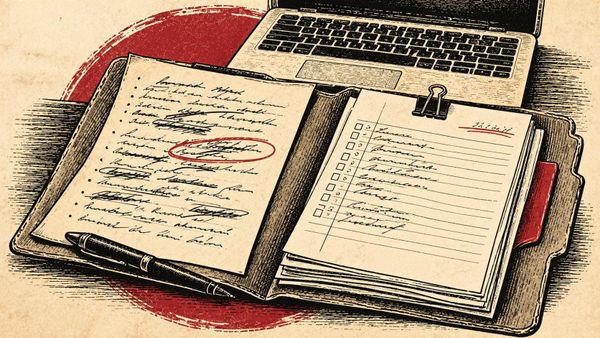
Your making process is the path from the records you found to the chronicle your family reads. Documenting it as you work is the practice.

Your making process is the path from the records you found to the chronicle your family reads: which sources you used, what you decided, and what you set aside. Documenting that path while you work, in plain files you keep, is the practice.
Most family historians already have a version of it. It sits in their head, in scattered notes, in a memory of why they chose one date over another. Then it fades, and eighteen months later the reasoning has to be done a second time.
This page is the permanent home for the practice. It covers what you document, what that gives you back, and what a Making Process is not.
Whether your conclusions came from the records or from the model
Here is the part that deserves your attention, and it has nothing to do with who typed the sentences.
Claude, ChatGPT and Gemini are all trained on enormous amounts of text. Ask any of them about your ancestor and you can get back a name, a date, a place, or a relationship. It came out of patterns in that training data, not out of any record about your family.
It will sound confident. It could fit. It could be wrong.
The line that matters is whether your conclusions came from the records or from the model.
That is a research question, not a writing question, and it is the same question family history has always asked. Where did this come from, and can you show me the source? A chat log with AI is not a source.
A check on your research answers that question for one ancestor at one moment. A Making Process is what makes the answer available for everything you have done, months after you stopped thinking about it.
What you document as you work
You document it in plain-text files, built as you go. Markdown suits the job, because it opens anywhere and will still open in fifty years.
Five things go in:
- The records themselves. Transcriptions, citations, images, and where each one came from.
- Your working notes. What you were trying to figure out at each stage.
- Your reasoning. Why you accepted one date over another. What you did with the conflict.
- Your reactions. The moment something surprised you. The point where the story turned out to be different than you thought.
- What the tools did, and what you did with it. What you handed over, and what you kept, changed, or threw out.
It is not tidy, and it is not meant to be. A Making Process that reads like a polished report has been sanitized, and the sanitizing removed the part that was worth keeping.
What it gives you back
The payoff is not defending yourself to a stranger. It is opening a file eighteen months later and finding out why you concluded what you concluded.
That happens more than family historians expect. You come back to an ancestor after a year spent on someone else, and your tree tells you the birth year you settled on and nothing else. Not the five records that disagreed. Not why one of them won.
The conclusion survived and the reasoning did not, so you research it again, and the second pass costs you a week you already spent once.
A Making Process keeps the reasoning attached to the conclusion. It also changes what you can hand to somebody else. A cousin, a child, or a researcher fifty years from now gets more than a set of answers to take on faith — they get the working, and they can continue it.
A Making Process is not a label
You have seen the notes at the bottom of articles. This content was created with the assistance of AI. Or the reverse: No AI was used in the writing of this piece.
Now ask what either one tells you about the work.
Nothing. Someone who typed every word can still build a family history on a guess. Someone who used AI at every stage can still trace every claim to a document they hold. The label sits on top of the work and provides zero information about the quality.
A label is a statement about your work. A Making Process is a record of it. Only one of those can be checked.
It is not a confession, either. You are not disclosing. You are documenting. If the permission question is what actually sits underneath this for you, that one has its own answer.
And nobody certifies it. A Making Process is self-attested, exactly the way a citation is self-attested. You wrote down where you got it and you signed your name. This is how family history has worked for a hundred years or more.
Keep it. Don't lead with it.
Your Making Process is for you first. Your future self is the main reader, and everyone else is hypothetical.
So do not volunteer it. Do not attach it to your chronicle, post it alongside your work, or open with it. Supplying your process before anyone asks is just a longer version of the label, and it invites people to grade your method instead of reading your ancestor's story.
No one has to justify their making process.
Say how you work if it comes up. Hand over the record if someone has standing to ask and a reason to care. Otherwise it sits on your drive doing its real job, which is keeping your own work straight.
Where the Making Process fits
Chronicle Makers publishes each of its standards at a permanent address, and each one answers a different question.
The Soundness Standard is the bar your research has to clear. The Making Process is the record of how you got from those records to a finished chronicle.
The Standard is the bar. The Making Process is how you built it.
Starting one
You do not need a system, and you do not need to go back and reconstruct the last ten years. A Making Process starts as one file, named for the ancestor you are working on now, sitting where the rest of that ancestor's material already lives. What makes it work is that you write in it while the work is happening rather than afterward.
Do it for one ancestor and you will see why it matters. Skip it and you will spend next spring rebuilding reasoning you already did once.
The Making Process™ — a framework from Chronicle Makers · Denyse Allen · chroniclemakers.com/making-process/ · First published August 2026.