The Research Quality Check: How to Know Your Research Is Ready to Become a Story
The Research Quality Check is the five-check standard family historians run on their research before writing an ancestor's story.


AI can now read old handwriting, summarize records, and draft family stories in minutes. What it cannot do is tell you whether the research underneath is sound enough to write a story. That part needs a standard, and most family historians were never given one.
The Research Quality Check is that standard. It is five checks you run on your own research about one ancestor, before you trust it enough to write their story. I built it for Chronicle Makers members as the gate into the Chronicle Writing Sprint, and I run it on my own ancestors before a word gets written.
Here is the standard itself, and why each check earns its place.
Why you need a check at all
The danger in family history is not having too few records. It is being confidently wrong with the records you have.
The number one failure I see is conflated identities. Records for two or more people with the same name get merged into one "ancestor," and everything written from that pile is fluently wrong. A full pantry, with ingredients from different meals.
AI has raised the stakes on this, because AI errors are fluent too. One family historian ran an AI transcription tool on a will written in 1696. The reading came back clean and confident, with details pulled in from somewhere else entirely, unrelated to the document in front of it. Another caught an AI-written family story reversing her grandmother's migration. The tool said she traveled to Montreal. The document showed she came from Montreal, through Vermont, to New York City.
Neither error announced itself. Both read matter-of-factly. A story your grandchildren inherit deserves better than confident and wrong, whether the confidence came from a merged identity or a machine.
The Research Quality Check: five checks
Run these on one ancestor's research and decide for yourself. AI can help with the clerical work. You decide what is true.
1. One person, or several?
The load-bearing check. Do all the records actually belong to the same individual? Same name does not mean same person. Lay out the life from birth to residences to marriage to children to death and look for collisions. A person in two places at once. A death before a later record. A child born after the mother died. Any unresolved collision means the identities are conflated, and the check is not clean.
2. Are the key facts held at honest confidence?
Every key fact about the life gets exactly one label. Three of them say how strongly the evidence supports the fact. Three say why it is not settled.
| Label | What it means |
|---|---|
| Proved | The evidence establishes it and nothing contradicts it |
| Probable | The evidence supports it, and the doubt is written down |
| Possible | Something points to it, not enough to call it probable |
| Conflicted | Two or more sources disagree and the disagreement stands |
| Unsupported | You searched where this fact should be recorded and it was not there |
| Open | Nobody has looked yet |
Unsupported and open are not the same finding. Searched-and-empty is a result. Not-yet-searched is a task. A check that cannot tell them apart will quietly overstate how much work has been done.
Overclaiming "proved" without the evidence to back it fails the check. So does marking a fact unsupported when nobody actually searched. Honest confidence is what separates research from wishful thinking, and it is exactly where a smooth AI summary will tempt you to overclaim what the research found (or did not find).
3. Originals, not just indexes?
Indexes and derivatives are where errors live. Mis-transcriptions, wrong names, merged people, and now AI interpretations with details imported from somewhere else. Every key fact should trace to an original record you actually examined. A fact built only on an index, or only on an AI's reading of a page you never checked, can be wrong.
4. Are conflicts named?
Your sources will disagree with each other. Sound research resolves each conflict with written reasoning, or flags it honestly as unresolved. None ignored. A conflict swept under the rug does not go away. It waits to pounce on the reader inside the story. A fact with an unresolved conflict is labelled conflicted and stays that way until the reasoning is written down.
5. Were the record groups that exist actually searched?
Not infinitely complete. Complete against a list. The record groups that exist for this person's place and time are a finite set, and the check asks whether each one was searched and the result logged, including the searches that found nothing.
The list itself has to come from somewhere you can name. A county wiki page, the statute that set a registration date, the repository's own finding aid — whatever you actually used, cited where the list lives.
This matters more since AI arrived, because an AI tool asked for the record groups of a county will produce a plausible list from nothing in particular. A list nobody can check is an opinion about what exists, and it cannot answer this question. Point the tool at the source rather than letting it work from memory.
Some of that list will be offline and awkward. My own local historical society has an online catalog open four hours a week, six months a year. That is a real limit, and it does not stop you — you log the unsearched group as open and write from the research you completed.
The verdict, and the deal
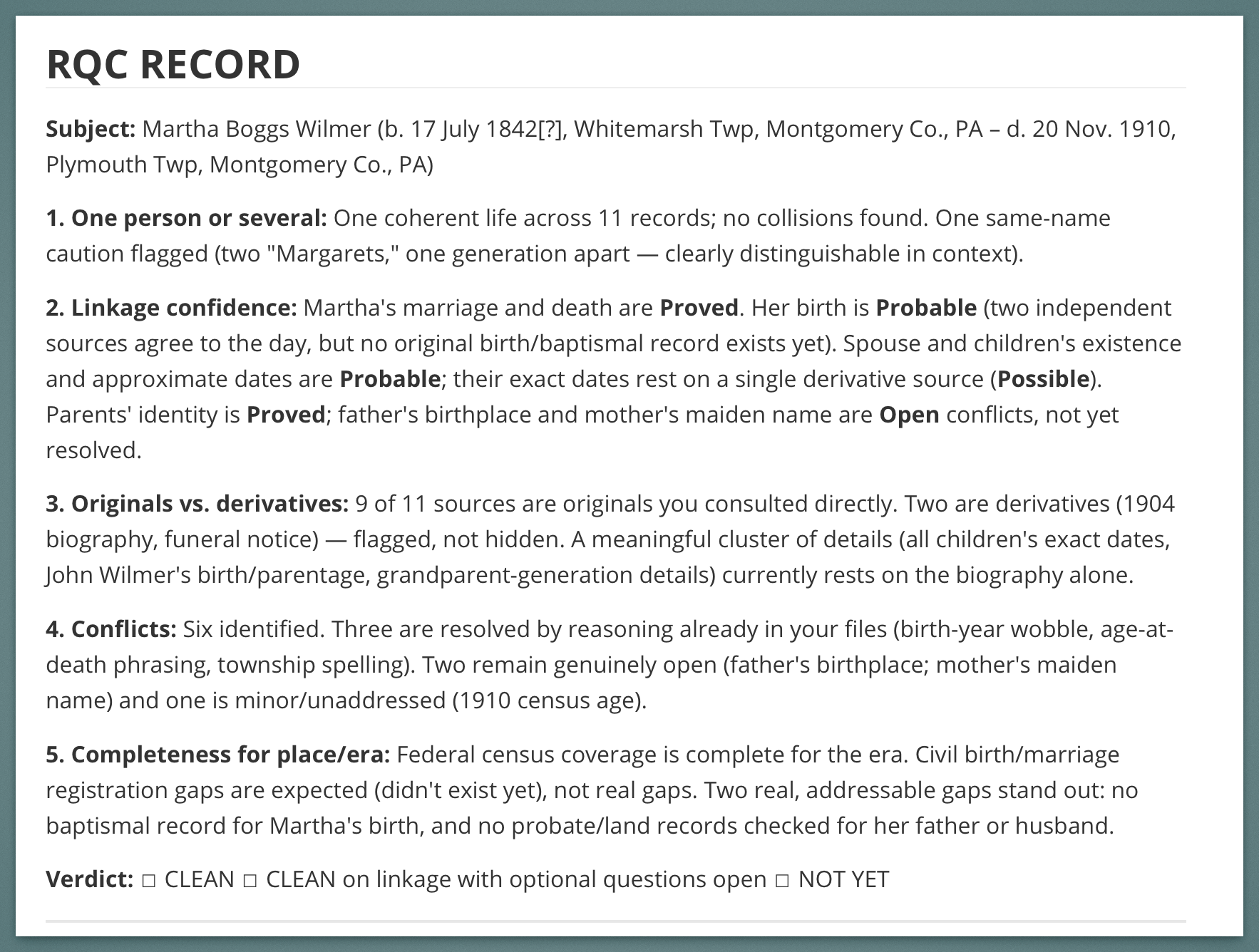
The check ends in a verdict, and it is allowed to come back clean. This is not a standard that always finds one more thing to do.
Clean means this ancestor is ready to be written. If the check comes back not clean because one named fact rests on an index, that is a finite fix. Go look at the original once, then re-run. But if the identities are conflated, the deal is stated up front: you do not go do more research. You pick a different ancestor, one you can write now. The check exists to get stories finished, not to postpone them.
What the check is, and what it is not
The Research Quality Check assesses your research. It is not a test of which AI tool to use. I run a separate evaluation, the 4R Model Test, on the tools themselves before they earn a place in my work. The 4R Test asks whether a tool should be let in the door. The Research Quality Check asks whether one ancestor's research is sound enough to become a story.
The check also has a place inside the AIM Framework, the Assess, Interact, Measure rhythm I teach for every AI working session. The Research Quality Check is the standard you measure against. Measuring is not asking whether the AI was right or wrong. It is holding the output against a named standard and using the difference to refine how you ask and how you work. AIM is the rhythm. The RQC is the yardstick.
Running the check is easier with company
The standard above is yours to use, today. Knowing the five checks and applying them under real conditions are two different skills, and the second one is where most people stall.
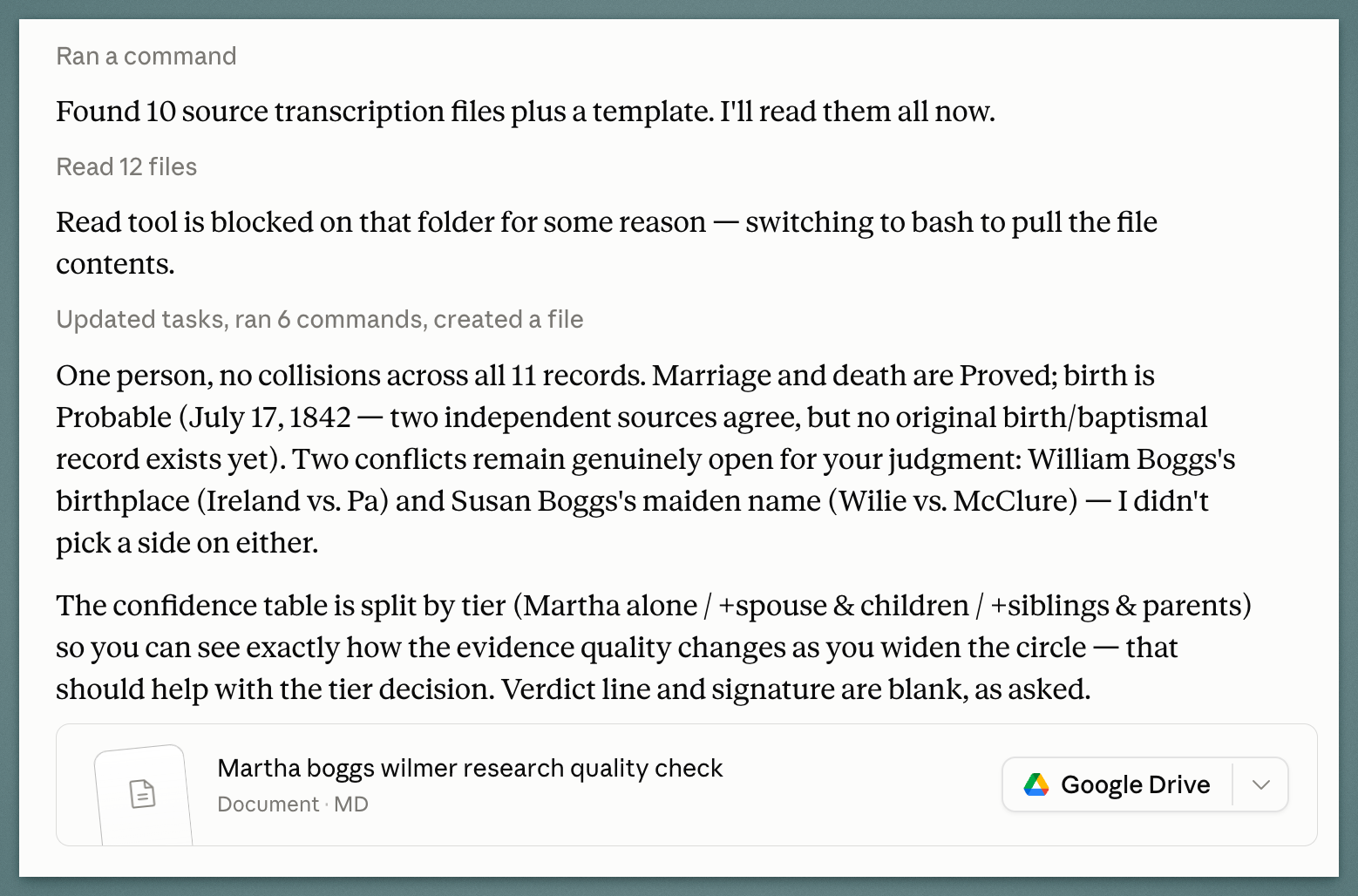
Inside the Chronicle Makers community, members run the Research Quality Check with the RQC Record, a template you fill in and sign, as a member tool that shows its reasoning. AI does the clerical lifting. You make every choice. A clean, signed Record is the ticket into the Chronicle Writing Sprint, because sound research is not the finish line. A finished story is. The STORI Method takes you the rest of the way.
If you want the wider picture of using AI safely in this work, start with Is AI Safe to Use for Genealogy Research? Then run the five checks on the ancestor you most want to write. The first time one comes back clean, you will know exactly what to do next.