AI and History Conference 2026: three things I'm taking to my work
1,600 people from 39 countries met to work out AI and history. The three changes I’m making to my family history work, with every session linked.
As of October 29, 2026
If you're a family historian wondering what to do with AI, the conversation is bigger than our field. On October 15 and 16, more than 1,600 people from 39 countries registered for the AI and History Conference, hosted by Johns Hopkins as an official conference of the American Historical Association. Most of them called themselves new to this.
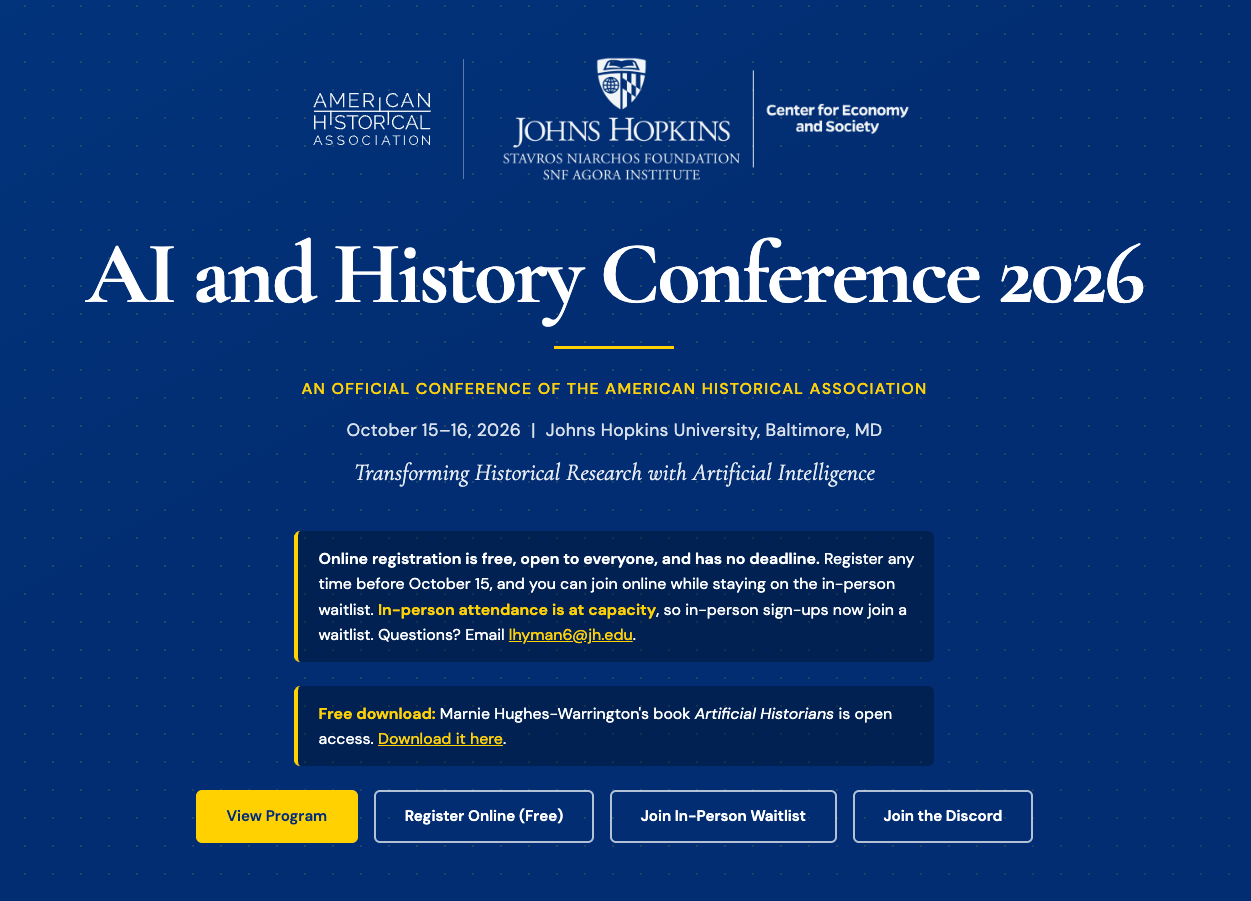
I went to listen. I came home with three changes to make in my own work. This isn't advice for anyone else's field. It's what I'm choosing to take on, from people who showed their work. The recordings are now online, and every session I mention below links to its video.
Measure the error, then say the number out loud
Samuel Backer (University of Maine) and Edward Gitre (Virginia Tech) led a session on trust and error. Backer pulls data from old theater booking ledgers with an LLM. He doesn't trust output because it reads well. He draws a random sample of about 100 pages and measures how often it's wrong. He'd rather the tool miss something than add something that was never on the page.
He also wants every archive project to state what the collection was, how much of it the researcher saw, and how that portion was chosen. He credits the idea to Claire Lemercier and Claire Zalc. When someone noted history has no agreed acceptable error rate, the panel's answer was simple: publish yours.
Backer's rule: sample the output, measure the error, publish the number.
What I'm taking: something missing is a gap I can go back and fill. Something added that isn't in the record is a reason to stop.
Build with the tool, and own what you build
S. Wright Kennedy (University of South Carolina) opened with a graveyard of research tools that died because they lived in someone else's cloud on someone else's money. The survivor he showed, GeoDa, has run free on people's own computers since 2003.
LLMs change who can build tools like that. Kennedy repaired a broken Zotero add-on in about an hour, at an airport, with Claude Code. The tool wrote the code — he chose the sources, the keywords, and what counted as meaningful, and he checked the results. He tests every new step on a small set where he already knows the answer.
Kennedy's test: tools that last run on your own machine and keep your data in plain files.
He closed with five questions for any research tool. Here they are as I noted them:
- Does it answer questions you couldn't otherwise ask?
- Do you know how to tell when it's giving you the wrong answer?
- Can someone else reproduce a result with it?
- Will it still run in two years if the providers change their pricing?
- Does its output flow into your other tools, or trap your data inside?
What I'm taking: everything I build or recommend goes through these five questions, with credit to him. His split between what the tool did and what he chose is the same line I drew when I stopped calling AI a collaborator.
Show your choices, not the tool's transcript
Loren Moulds (University of Virginia School of Law) showed an archive pipeline where every extracted data point records which model produced it, when, with what prompt, and which page it came from. Louis Hyman (Johns Hopkins), the conference organizer, argued that inspectable, rerunnable work can restore trust, and that the skill worth teaching is noticing when a result is too clean to be true. His own write-up on running the conference ends with a table of every figure, its source and its caveat, plus a box listing what went wrong.
A transcript shows what the tool said. A record of choices shows what the researcher kept, threw out, and why.
What I'm taking: any number I publish gets its source and its caveat, and I'll say what went wrong. It's why I built the Making Process around what the person did, not what the tool said.
The conversation is wider than you think
These historians earned their authority by being willing to be wrong in public. They ran pipelines live and published their error rates. Ruth Mostern (University of Pittsburgh), who directs the World Historical Gazetteer, said she wants contributions from people who know a single place deeply. That describes a lot of family historians I know.
You don't have to wait for consensus before using AI. Other fields are working it out in the open, and every session is now online, free to watch.
Links
- How I use these tools in my own work: AI for genealogy
- Conference program and speakers: AI and History Conference 2026. Every session was recorded, and all 27 recordings are now online.
- Marnie Hughes-Warrington, Artificial Historians (Routledge, 2025). She gave the opening plenary, and the book is open access: free download.
- Louis Hyman, Computational History on Substack
- Edward Gitre, The American Soldier in World War II
- Loren Moulds, UVA Law profile
- Ruth Mostern, World Historical Gazetteer
- Claire Lemercier and Claire Zalc, Quantitative Methods in the Humanities: An Introduction (2019), the source of the coverage-statement idea
- Jacob Polay and colleagues, OCR benchmark on archival documents, 1612–1921