I Stopped Calling AI a Collaborator. Here's Why.
I called AI a collaborator for two years and then stopped. The word was telling family historians their own research and writing belonged to something else.

For two years I called AI my collaborator. I used the word in courses, in emails, on video. This year I stopped.
I picked the word to make people less afraid, and it worked. What I did not expect was watching them accepting story drafts they did not like and treating a research suggestion as a verdict instead of a hypothesis.
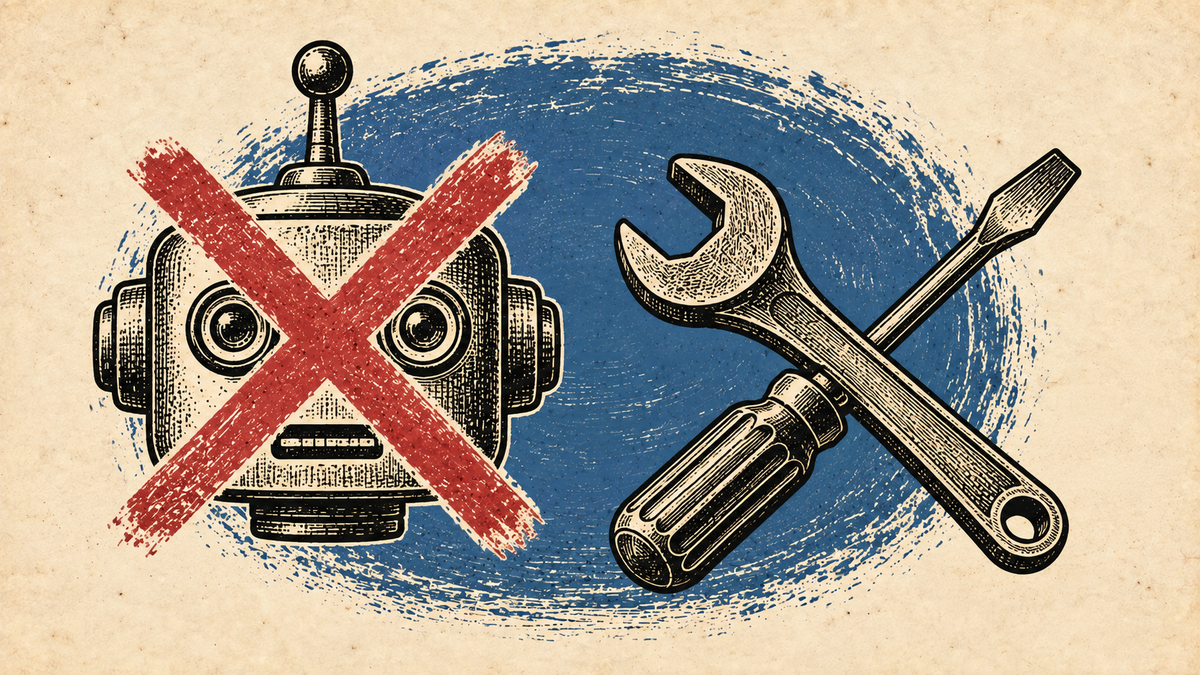
You do not argue with a collaborator. You do redirect a tool.
Here's what I say now, and why it matters for your work.
Why I picked that word in the first place
I'll own this. I chose "collaborator" (and also "assistant") because it was more friendly than saying "tool."
Family historians were arriving scared. The question underneath every early conversation was am I cheating? Calling AI a collaborator made the work sound shared. Calling it an assistant made it sound like they were in control. It gave people cover to try AI.
It worked and it also cost more than I expected.
AI is not a collaborator
Open Claude right now and watch what happens.
Nothing.
It sits there until you act. You choose the ancestor. You gather the records. You decide which of them matter and which are noise. You name what you're trying to make. Only then does anything move, and what moves is a response to what you brought.
A collaborator brings something to the table. AI brings capability, and capability isn't contribution. You have to initiate and choose the action AI does.
It has no stake in whether you finish
Your AI does not care whether you finish.
It won't wonder about your ancestor next Tuesday. It won't notice you've gone quiet for three weeks. It has no preference about whether the chronicle gets written, gets read, or gets abandoned in a folder.
Whatever it retains between sessions, it is not carrying your ancestor around in the meantime. You carry the thread. You carry the caring.
A collaborator with no stake in the outcome is not a collaborator. It's a tool you're very good at using.
Responsiveness isn't personhood
People push back on the tool framing, and I understand why. AI answers. It adjusts. You say that's too flowery and it changes. That feels like a relationship.
It isn't. Back-and-forth is what good tools do.
A camera responds to light and to every choice you make about it. A search box takes what you typed and hands back something you then have to judge. Nobody calls a camera a partner. Responsiveness is a property of well-designed technology, and we've had it for a long time.
What's new is that this one responds in sentences.
And here's the test that settles it for me. Nobody ever called Google a collaborator.
Search shapes what you find, what you consider, and what you end up concluding. It arguably has more influence over a research outcome than a drafting tool does. Yet no one ever asked whether an essay was a joint effort with a search engine, and no one apologized to a search box. The collaborator framing was never tracking how much the tool contributes. It was tracking how much the tool sounds like a person.
The one argument for AI as collaborator
There is a serious case for personifying AI.
People are careful with people and careless with tools. We trust a calculator without checking it, and mostly that's fine. If you trust AI the way you trust a calculator (and plenty of people do this), you could end up with a fabricated ancestor in a document you hand to your family.
That risk is real. But the answer isn't to treat the tool as a person to manage. The answer is to accept that this tool is generating responses. Responses which are confident, fluent, correctly formatted, and (possibly) invented. That's how LLMs work. That's why the checking in my courses is procedural. It's a standard you run, not a feeling you have about how AI acted that day.
You don't verify because it might be lying to you. You verify because that's what the process requires.(It always did.)
Why the label matters
Call it a collaborator and you've imported a relationship. Relationships come with obligations, and obligations come with permission questions.
Do I need to credit it? Is this really mine? Is it okay that I used it? What will people think?
That last one usually has a face attached to it. Someone who said it, or someone you're bracing to hear it from. So keep this response where you can reach it:
When someone tells you that using a tool makes the work no longer yours, they've said something about what they think of you, not about the tool.
The rest of those questions feel like ethical dilemmas. They're not. They're a category error, and they'll keep you from finishing the work your family is waiting for.
Call AI a tool and the questions collapse into two real questions:
Is the work sound? Is it yours?
Sound means every fact traces to a record and nothing invented is presented as true. Yours means you made the choices: what to keep, what to cut, how it should sound.
Answer those two and you're done. Nobody needs to know how you feel about your software.
How I got here
I use AI every day, for research and for writing, and I teach other people to do the same. I don't call it a partner, a collaborator, an assistant, or a nickname. I call it a tool, and I'm precise about what I did with it and keep a log of everything I create with it.
That precision is how I stay in control and use AI to power what I do, not overpower me.
Your ancestors' stories deserve a researcher and a writer, not a collaborator with no stake in the outcome. You're the maker of your family history. You always were.