Is AI Safe to Use for Genealogy Research?
Is AI safe for genealogy? Yes, with guardrails. Here are the three risks, how to catch each one, and the verification habit that protects your research.

The question I hear most often from family historians trying AI for the first time: "Can I trust what it tells me?"
The short answer is no and that's fine. You don't trust it. You check it's work. The same way you check any source in genealogy.
The longer answer is that AI for genealogy is safe when you understand the three ways it fails and build one simple habit into your workflow.
AI is a collaborator, not an authority
This distinction matters more in genealogy than in almost any other field.
When you ask AI to write a marketing email, a wrong word is a minor annoyance. When you ask AI about your ancestors, a wrong date goes into your family tree. A wrong name gets passed to your children. A fabricated record gets cited as evidence.
The stakes are real. But the fix is not to avoid AI. The fix is to use it the way you'd use any research partner: listen to what it says, then check it yourself.
Every experienced genealogist already does this. You don't accept a census transcription at face value, you compare it to the original image. You don't trust a published family history without checking its sources. AI is no different. It gives you information. You check it for accuracy it.
The three ways AI fails in genealogy
AI does not fail randomly. It fails in specific, predictable patterns. Once you know the patterns, you can catch them.
Confabulation: inventing things that sound right
AI generates text by predicting what should come next based on patterns. When it doesn't have enough information, it fills the gap with something plausible. In genealogy, this means AI will sometimes invent dates, create records that don't exist, or cite sources with real-sounding titles that you cannot find anywhere.
The output reads as confident. AI does not say "I'm making this up." It presents invented information with the same tone as verified facts.
How to catch it: Never add any fact from AI to your family tree without verifying it against an original source. If the AI says a record exists, find that record yourself. If it gives you a date, check it against a document. If it cites a source, look up that source. If the source doesn't exist, the AI fabricated it.
Merging people with similar names
AI struggles with same-name individuals in the same place and time period. If three men named John Smith lived in Lancaster County in 1830, AI will sometimes combine information from all three into one person without telling you it's doing so.
This is dangerous because the merged profile looks coherent. The dates make sense. The locations line up. But the person described is a composite who never existed.
How to catch it: Be explicit when you give AI information. Include birth years, spouse names, and township-level locations. When the AI gives you information about a person, ask it to identify which specific individual the information applies to and which record it comes from.
Over-interpreting records
AI reads what's on the page. It cannot know what's not on the page. A census record showing a family of four doesn't mean there were only four children — it means four were home on census day. A missing name from a tax list doesn't mean the person moved — it might mean the assessor skipped a road.
AI sometimes draws conclusions from records that the records don't support. The interpretation sounds reasonable but goes beyond what the evidence actually says. This happens often if we use AI as an agent to search on our behalf.
How to catch it: Ask the AI to separate what the record says from what it might mean. "Tell me what this document states, then separately tell me what you think it implies." Treat all implications as hypotheses you test, not conclusions you accept.
The one habit that makes AI safe
Source check.
Every fact. Every date. Every name. Every citation. Checked against an original source before you trust it.
This is not a new requirement. This is what good genealogy has always demanded. AI doesn't change the standard. It changes the speed. You get information faster, which means you need to verify faster, but the standard is exactly the same.
Build this into your workflow as a non-negotiable step. After every AI session, your job is to verify what the AI gave you before it goes anywhere near your family tree, your research notes, or your chronicle.
While working on a research plan with Claude AI, it stated that the children's births were confirmed by the church records being published in the Pennsylvania-German Society Proceedings.
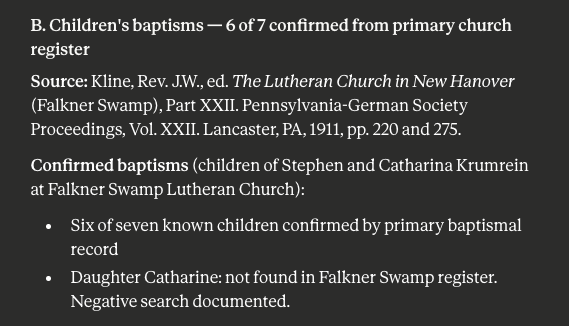
The problem? Neither Claude nor I actually looked at that volume of the Pennsylvania German Society Proceedings. What AI is citing here needs to be confirmed by my eyeballs looking at the source itself, verifying the information is there, and downloading it to my files.
What about privacy?
Family historians work with sensitive information. Names, dates, locations, family relationships, DNA data, living relatives. Handing this to an AI tool raises legitimate privacy questions.
Here is what you need to know about the major tools:
Claude (Anthropic): As of 2026, Claude uses your conversations for model training by default. Turn this off in Settings → Privacy before uploading any family information. Use Projects to keep research contained. Use Incognito mode for one-off conversations you don't want saved.
ChatGPT (OpenAI): Similar default. Check Settings → Data controls and turn off the training toggle if you don't want your conversations used.
Gemini (Google): Also a similar default. Check Settings → Personalized Intelligence to toggle it off. Be cautious with sensitive family information.
All tools: Do not upload DNA data, Social Security numbers, or any information about living relatives. Use the tools for historical research on deceased ancestors. That's their sweet spot.
The real risk is not using AI wrong — it's not using it at all
Here is the risk nobody talks about.
An estimated 98% of genealogists who want to write about their ancestors never finish. Not because of AI. Because of the blank page, the organizational overwhelm, the "I don't know how to start" paralysis that has been the default state of family history for decades.
AI removes that paralysis. It organizes your research. It builds timelines. It produces scaffolding you can rewrite. It lets you go from "I have a folder of documents" to "I have a rough draft I can shape" in an afternoon.
The risk of using AI carelessly is wrong information in your tree. That risk is manageable with verification.
The risk of not using AI at all is that your ancestor's story never gets written. That risk is permanent.
Frequently asked questions
Will AI replace genealogists? No. AI cannot visit an archive. It cannot interview a living relative. It cannot decide what a record means in the context of a specific family. AI handles the mechanical work — transcription, organization, drafting — so you can focus on the interpretive work that only a human can do.
Can I cite AI in my research? No. An AI response is not a verifiable source. It is a starting point. The original record, the published work, the archive collection — those are your sources. AI helped you find them or understand them. The source is the source.
What if AI gives me wrong information about my ancestor? This will happen. It is not a crisis. It is a normal part of working with any tool. Check the information against original records. If it's wrong, discard it. If it's right, cite the original source, not the AI.
Is my family information safe with AI tools? As safe as you make it. Turn off training data settings. Don't upload information about living people. Use the privacy controls each tool provides. Treat AI tools with the same caution you'd give any online service that handles personal information.