How Much Research Is Enough Before Writing Family History?
How to know when you have enough genealogy research to start writing. The Chronicle Compass tool and the evidence that "enough" is less than you think.

You've been researching for five years. Or ten. Or twenty-five. And every time you think about writing, the same question stops you: do I have enough?
The answer, almost always, is yes. You have had enough for a long time. The question is keeping you in the research because the research is comfortable and the writing is not.
Why "enough" feels impossible to reach
Genealogy research has no natural finish line. There is always another record, another archive, another lead. Every document you find raises new questions. The feeling that you need "just one more thing" is structural — it's built into the activity, not into your personality.
This is not laziness. This is a researcher doing what research is designed to do: expand. The problem is that expansion has no endpoint. You will never reach a point where every question is answered, every gap is filled, every source is exhausted. That moment does not exist.
If you wait for it, you will never write.
The Chronicle Compass assessment
The Chronicle Compass is how you know whether you have enough research to write about a specific ancestor. It's not about having everything. It's about having enough to tell one story honestly.
Five questions:
Do you know the ancestor's basic life facts? Birth date (approximate is fine), death date, marriage, children, location for at least part of their life. If you have these anchors, you have enough for a chronological framework.
Do you have at least three different record types? Census, vital records, land records, church records, military records, newspaper mentions, court records, probate, tax lists. Three different types give you corroboration and texture. One record type alone is thin. Three gives you a story.
Can you identify a central question or theme? Not "the life of Great-Grandpa." Something specific: How did he lose the farm? Why did she leave Ireland? What happened during the war years? If you can name the question, you have a story angle.
Do you know where the gaps are? Knowing what you don't know is as important as knowing what you do. If you can say "I have nothing between 1885 and 1892" — that's a known gap. You can write around it honestly. Unknown gaps are the ones that cause problems.
Could you explain this ancestor to a stranger in five minutes? If you can tell the basic story out loud — who they were, what happened to them, why it matters — you have enough to write. The writing is just that conversation, slowed down and grounded in sources.
If you answered yes to four of five, you are chronicle-ready. Start writing.
Learn more about the Chronicle Compass →
"Enough" is less than you think
Here is what surprises most family historians when they finally sit down to write: the story doesn't need everything you've found. It needs a fraction.
A chronicle about how your grandmother survived the Depression doesn't need her complete census history from 1900 to 1950. It needs the 1930 census showing the family renting instead of owning, the 1935 tax record showing the property transfer, and the family photograph from 1938 with the new house in the background. Three documents. One story.
Your research folder might contain fifty documents about this ancestor. The chronicle uses twelve. The rest are backup — they confirm what you already know or cover a different chapter of the story you'll write next time.
This is why scope matters. A scope statement says "this story covers 1928 to 1940 and answers the question of how they kept the farm." Everything outside that boundary is material for a future chronicle, not evidence you need to find before you can start this one.
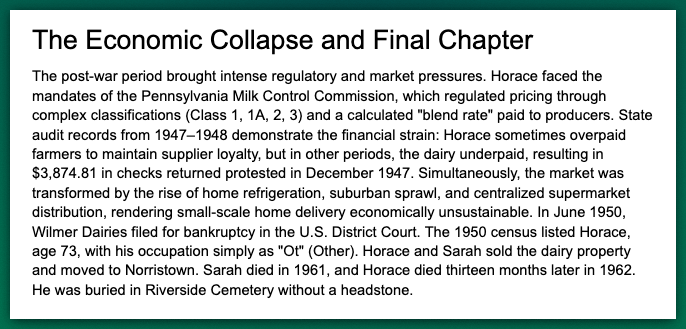
This paragraph from a chronicle about a family dairy used only three types of records: the dairy bankruptcy file, the 1950 census, and death certificates. The majority of this story comes from historical context of that time period, not just the genealogical records themselves. This is how so few records turn into a interesting story.
The real cost of waiting
Every year you spend researching instead of writing is a year the story doesn't exist.
Your uncle who remembers the family stories is a year older. Your cousin's children are a year further from caring. The audience for your ancestor's story — the living people who would read it and feel something — gets smaller with each year that passes.
This is not pressure. It's arithmetic. The people who would most value your family's stories are alive now. Some of them will not be alive in five years. Writing a good-enough story today is worth more than writing a perfect story after the people who would have read it are gone.
What to do with the gaps
Gaps do not disqualify a story. They make it honest.
"No records survive from the years between 1865 and 1872. We know John was in Lancaster County in 1864 because of the tax list, and we know he was in Chester County by 1873 because of the deed. What happened in between is a question his records don't answer."
That paragraph is better genealogy than inventing a smooth narrative that papers over the gap. Your readers trust you more when you show them what you know and don't know. The gaps are part of the story. They are not a reason to postpone the story.
AI tools help here. Ask Claude to identify the gaps in your research and suggest what records might fill them. If the records exist and are accessible, go find them. If they don't exist or aren't accessible, write the story with the gap acknowledged. Done is better than hypothetically complete.
The decision
You're reading this because some part of you already knows you have enough. The question isn't really "do I have enough research?" The question is "am I ready to be someone who writes?"
The answer to the second question is always yes if you decide it is.
Pick one ancestor. Write a scope statement. Build a timeline from what you have. Draft the story. Share it with someone.
You have enough. You can start.