Perplexity for Genealogy: When to Use It (and When Not To)
Perplexity for genealogy: when to use it for sourced historical context and when another AI tool is the better choice.


Perplexity is the AI tool that cites its sources. For genealogists trained to document every claim, that matters.
But Perplexity is also the tool genealogists are most likely to misuse — asking it to do things it was never built for. Understanding the difference between what Perplexity does well and what it doesn't saves you hours of frustration.
What Perplexity actually is
Perplexity is an AI-powered answer engine. It combines a language model with live web search. When you ask a question, Perplexity searches the web, reads the results, synthesizes an answer, and cites each source with a numbered link you can click and verify.
It runs at perplexity.ai in your browser and has a mobile app. The free version handles most genealogy research questions. Perplexity Pro ($20 a month) gives you more searches per day, access to stronger models, and the ability to upload files.
Perplexity is different from Claude, ChatGPT, and Gemini in a fundamental way. Those tools generate text from what they learned during training. Perplexity generates text from what it finds on the web right now. That distinction matters for genealogy.
Three things Perplexity is genuinely good at for genealogy
Finding historical context with sources you can check
You're writing about an ancestor who farmed in Lancaster County in the 1920s. You need to know what happened to dairy prices during that decade, what the local economy looked like, and whether there was a drought in 1925.
Ask Perplexity. It searches the web, finds relevant sources — university agricultural archives, historical society publications, newspaper archives — and gives you an answer with links to every source. You click the links, verify the information, and cite the original source in your chronicle.
This is genealogy research the way it's supposed to work: a tool that finds things and shows you where it found them.
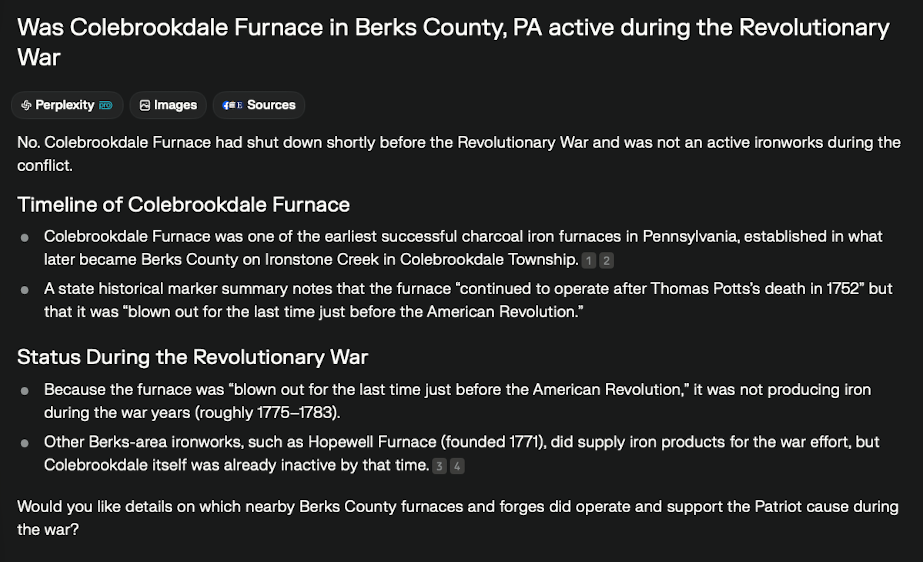
For example, I have a Revolutionary War ancestor who lived in Colebrookdale Township during the war. I was curious if the iron furnace that was there was operating at the time. I sent this simple sentence to Perplexity and it summarized the sources it found on the internet. For each item in the summary there is a footnote I can click on to view the website it came from.
Identifying repositories and archives
Where are the church records for German Reformed congregations in Berks County, Pennsylvania? Which historical society holds the tax records for Bucks County before 1800? Is there an online index for Philadelphia marriage records from the 1870s?
These are questions Perplexity answers better than any other AI tool because the answers require searching current web sources — repository websites, finding aids, digital collection catalogs — not generating text from training data.
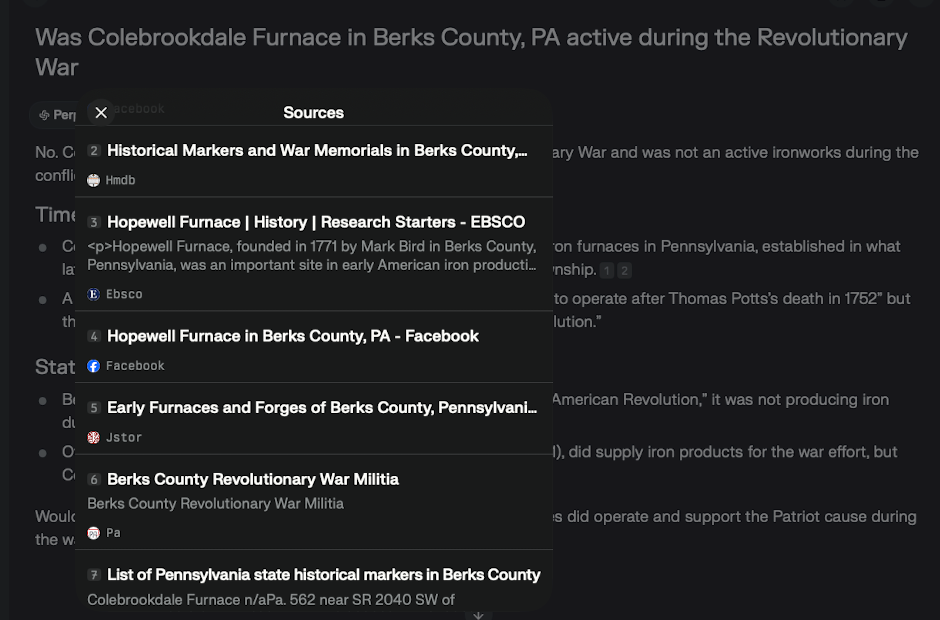
If I click the "Sources" in the Perplexity results, I can see all the websites used as a list. In a glance I can evaluate which of these are likely more reputable than others. For instance, that Jstor result, "Early Furnaces and Forges of Berks County, Pennsylvania," is probably a journal article or history book.
Verifying AI-generated claims
Here's a workflow that combines tools effectively: Claude drafts a timeline for your ancestor that includes historical context. Some of that context came from Claude's training data, which may or may not be accurate. You take the specific factual claims — dates, events, economic conditions — and ask Perplexity to verify each one with current sources.
Perplexity finds the supporting evidence or tells you the claim doesn't match what's available online. Either way, you end up with verified context you can trust.
Three things to be careful about with Perplexity
1.It cannot read your documents reliably
Perplexity searches the web as it default use. When you upload old deeds and ask it to transcribe the handwriting, it may work or it may not. Some people get a response analyzing the document, not a transcription of the document itself.
For document transcription, use Claude, ChatGPT, or Gemini. Perplexity is for finding context around the documents you've already read.
2.Web sources are not always reliable
Perplexity cites its sources, which is valuable. But the sources themselves — family trees on Ancestry, blog posts by other genealogists, Wikipedia articles, forum discussions — range from solid to unreliable. A cited source is not a verified source. You still need to evaluate the quality of what Perplexity found.
The best use is when Perplexity leads you to a primary source or a trusted institutional repository. The worst use is when you accept a claim from someone else's unsourced family tree just because Perplexity cited it.
3.It doesn't hold project context
Like ChatGPT without memory, Perplexity treats every query independently. It doesn't remember that you're researching the Wilmer family in Lancaster County or that you've already checked the county deed records. Every question starts fresh.
This makes it excellent for one-off research questions and poor for extended research sessions where context builds across many questions. For project-based research, you need to subscribe to the Perplexity paid plan and set up a Project. With the paid plan you also get the option for "deep research."
The under-30-minute setup for genealogy
Step 1: Go to perplexity.ai. Sign up for a free account. No paid plan needed to start.
Step 2: Ask a question you already know the answer to. Test it on a factual question about your ancestor's time and place where you can verify the result. See how the sourcing works and how accurate the answers are for your research area.
Step 3: Try a repository search. Ask: "Where are the [record type] records for [county], [state] before [year]?" Compare the answer against what you already know about the available repositories. Note any it finds that you hadn't considered.
Step 4: Test the confirmation workflow. Take a specific claim from a Claude or ChatGPT session — a date, a historical event, an economic condition — and ask Perplexity about it. See whether the sources it returns are reliable enough to cite.
Step 5: Bookmark it as your context tool. Perplexity works best as a research companion alongside Claude or ChatGPT, not as a replacement. Use it for the questions that need current web sources and verified citations.
When to use Perplexity vs. another AI tool
Perplexity is the right tool when you need factual information with sources you can check. Historical context, repository locations, legal terminology, economic conditions, community histories — anything where the answer lives on the web and you need to know where it came from.
Claude is the right tool for reading your documents, writing narratives, and building research projects that carry context across sessions. ChatGPT is strong for quick questions and brainstorming. Gemini is best for reading or transcribing structured records where page layout matters.
The most effective genealogy workflow uses Perplexity for context and verification alongside Claude for reading, writing, and project management. Two tools, two jobs, no overlap.